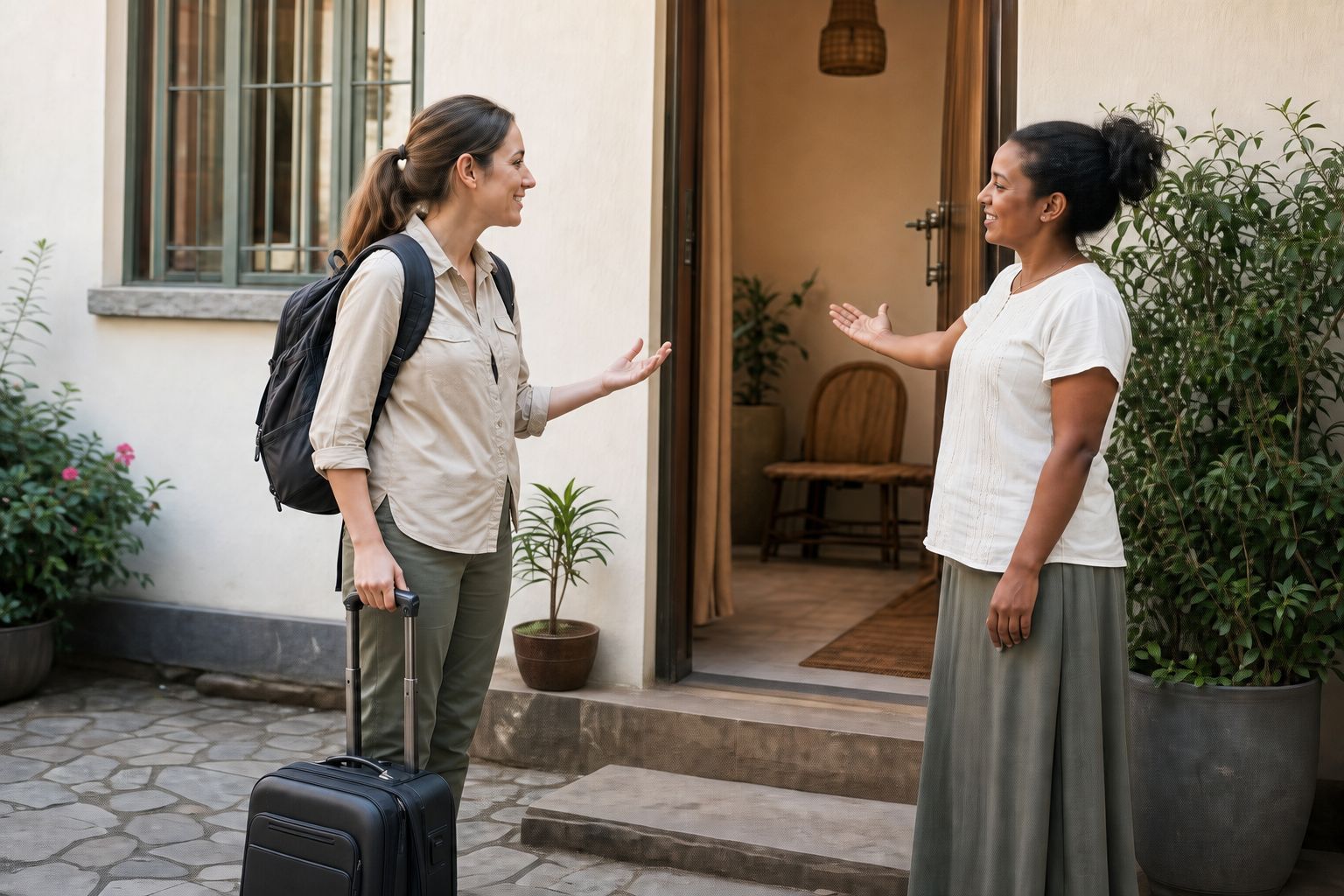
An illustrative greeting between a traveler and an Ethiopian host.
One clear greeting can make the next part of a conversation easier. It will not turn a beginner into an Amharic speaker, but it shows attention and gives the other person a chance to slow down.
Amharic is widely used in Addis Ababa and in many conversations across Ethiopia. It is not the first language of every Ethiopian. Afaan Oromo, Tigrinya, Somali, Afar, Sidama, Wolaytta, and many other languages are used in daily life. Learn the local greeting when you know the area, and never treat someone else’s language as an obstacle.
The phrases below use polite forms where possible. The Roman spelling is only an approximation. Listen to a fluent speaker before relying on it.
Every Amharic script form, Roman spelling, translation, and pronunciation note below is offered as a starting point, not a finished record. Have a qualified contemporary Amharic teacher check the full list against how the language is actually spoken today before you treat any single entry as settled.
For a smaller recognition list before practising complete phrases, begin with common Amharic words for visitors.
How to read this guide
Each phrase appears first in Amharic script, then in a simple Roman form, then in English. Roman spelling varies across books and apps, so you may see the same phrase written differently.
Amharic contains sounds that English spelling does not represent neatly. In words such as algebagnim, the letters gn stand for the sound written ኝ, somewhat like the middle sound in canyon. Vowels can also sound different from the nearest English letter.
Do not chase a perfect accent on the first day. Focus on rhythm, clear listening, and a respectful tone.
Greetings that work first
- ሰላም
Selam
Hello or peace.
Selam is short and widely understood. It works with people you know and in many informal encounters.
- ጤና ይስጥልኝ
Tena yistilign
A respectful greeting, literally wishing health.
This is more formal. Check the pronunciation and exactly when it fits socially with a fluent speaker, since formality in Amharic shifts with context in ways a phrase list cannot fully capture.
- ደህና ነዎት?
Dehna newot?
Are you well?
This is a polite form. Informal forms change according to the person addressed, which is one reason the respectful form is useful for a beginner.
-
ደህና ነኝ
Dehna negn
I am well. -
ስሜ … ነው
Sime … new
My name is …
Pause after sime and say your name. You do not need to force it into an Amharic sound pattern.
Courtesy words worth memorising
- አመሰግናለሁ
Ameseginalehu
Thank you.
This word is long, but it is worth learning as one sound sequence. Listen, repeat slowly, then speed up.
- እባክዎ
Ibakwo
Please, in a polite form.
Informal please changes with the gender of the person addressed. Ibakwo avoids that choice and is suitable in respectful conversation.
- ይቅርታ
Yikirta
Excuse me or sorry.
Use it to get attention gently, apologise for a small mistake, or pass through a crowded place.
-
አዎ
Awo
Yes. -
አይ
Ay
No.
Tone matters. A short no can sound abrupt in any language, so add yikirta or ibakwo when the situation needs softness.
When you do not understand
- አልገባኝም
Algebagnim
I do not understand.
This is more useful than pretending you followed a price, direction, or instruction.
- ቀስ ብለው ይናገሩ
Kes bilew yinageru
Please speak slowly.
This is a polite instruction. Listen to recorded native speech to get the exact pronunciation right, since the Roman spelling here can only approximate it.
- እንግሊዝኛ ይናገራሉ?
Ingilizigna yinageralu?
Do you speak English?
Ask without assuming. A person may know another language that helps, or may call someone who does.
Showing a written place name can be more effective than repeating it louder. Keep the hotel address in Amharic script when possible.
Prices and buying
- ስንት ነው?
Sint new?
How much is it?
Ask before a service begins when the price is not displayed. Make sure you and the seller are discussing the same unit, quantity, or journey.
- ይህ ስንት ነው?
Yih sint new?
How much is this?
Point to the item without touching delicate craftwork.
- ደረሰኝ እባክዎ
Deresegn ibakwo
A receipt, please.
Check the word for receipt and this full phrase with a fluent speaker in the setting you plan to use it, since wording that works in one shop may sound off in another.
Numbers are easy to confuse when noise, accent, and unfamiliar notes are involved. Ask the person to type the amount into a calculator or phone if necessary. Confirm the currency and total before paying.
The budget travel guide for Ethiopia explains how price checks fit into a wider plan for transport, rooms, food, and emergency money.
Directions and transport
- የት ነው?
Yet new?
Where is it?
Put a place or object before the phrase.
-
ሽንት ቤት የት ነው?
Shint bet yet new?
Where is the toilet? -
ወደ … መሄድ እፈልጋለሁ
Wede … mehed ifeligalehu
I want to go to …
Say or show the destination after wede. For a taxi, display the full address and a nearby landmark rather than relying only on a hotel name.
- እዚህ ያቁሙ እባክዎ
Izih yakumu ibakwo
Please stop here.
Confirm the exact form and pronunciation with a fluent speaker before you rely on it in a moving vehicle, where being understood quickly matters.
Useful direction words include:
- ግራ, gira, left
- ቀኝ, kegn, right
- ቀጥታ, ketita, straight
Listen for these words, but do not rely on spoken directions alone in an unfamiliar area. Check a map and ask a second person when the route is unclear.
Food and water
-
ውሃ እባክዎ
Wuha ibakwo
Water, please. -
ምግብ እፈልጋለሁ
Migib ifeligalehu
I want food.
This is understandable but broad. A menu photograph, dish name, or dietary card will help more.
- ሥጋ አልበላም
Siga albelam
I do not eat meat.
This does not automatically communicate every vegetarian or vegan restriction. Butter, egg, broth, dairy, and cross contact require separate explanation, and it is worth checking the exact dietary wording with a fluent speaker or local food expert before you depend on it for a serious allergy.
Fasting food may be useful for vegan travellers because many dishes avoid animal products during Ethiopian Orthodox fasting periods. Still ask about ingredients instead of assuming every item is suitable.
Help and health
-
እርዳታ እፈልጋለሁ
Irdata ifeligalehu
I need help. -
ሐኪም እፈልጋለሁ
Hakim ifeligalehu
I need a doctor.
Both of these are safety phrases, not casual vocabulary. Have a fluent speaker confirm the grammar and let you hear them said before you travel, not after.
- ሆስፒታል የት ነው?
Hospital yet new?
Where is the hospital?
In an emergency, a phrase list is not enough. Carry insurance details, medicine information, allergies, and an emergency contact in writing. As of a check on 6 August 2026, Addis Ababa police publish 991 for police and 907 for the Red Cross, and United States State Department guidance lists the same two numbers, which makes those the better supported ones to write down. Do not treat them as a guarantee outside the capital or as settled beyond question: United Kingdom government guidance differs from both the Ethiopian and US lists, and sources disagree specifically on the fire number, which appears as 907, 912, or 939 depending on the source. Confirm the fire number locally rather than relying on any single figure here, and recheck all three numbers for the specific area you are visiting.
Ending the conversation
-
ደህና ሁኑ
Dehna hunu
Goodbye, in a respectful or plural form. -
አመሰግናለሁ
Ameseginalehu
Thank you.
Repeating thanks at the end is natural and useful.
Practise phrases as small scenes
Reading a list once does not create usable speech. Practise in groups of three.
For a shop:
- Selam
- Yih sint new?
- Ameseginalehu
For a taxi:
- Selam
- Wede … mehed ifeligalehu
- Izih yakumu ibakwo
For a misunderstanding:
- Yikirta
- Algebagnim
- Kes bilew yinageru
Record a fluent speaker saying each group at normal speed and slow speed, with permission. Listen and repeat while looking away from the page. Then compare your recording.
Practise with background noise too. A phrase that feels easy in a quiet room may disappear at a bus terminal or market. Keep the volume low enough to protect your hearing, then try to recognise the key word without reading. If you miss it, replay the whole sentence rather than isolating one sound forever. Real speech joins words together, and learning that rhythm is part of understanding.
Now rehearse a complete exchange with a partner. The partner acts as a ticket seller and answers at normal speed. Greet them, show the destination in Amharic script, ask the price, and repeat the amount back. If you do not understand, use yikirta and algebagnim, then ask for slower speech. Do not guess or nod merely to end the conversation. Ask the partner to type the number and point to the departure place.
Switch roles and repeat without the Roman spelling. Afterward, write down which part failed: recall, pronunciation, listening, or context. Practise only that point, then run the whole exchange again. A phrase is ready for travel when you can recognise a natural reply and recover politely from confusion, not only when you can recite your own line.
Have a fluent speaker review the scene before you rely on it. Use fictional destinations and payment details during practice.
Respect the language you are hearing
Do not assume that Amharic is the correct language in every place. Ask which language is used locally. A greeting in Afaan Oromo, Tigrinya, Somali, or another local language may be more appropriate.
If someone replies in English, that does not mean your effort failed. The point is connection, not forcing a lesson on a busy driver or cashier.
Carry a short list, use it calmly, and be willing to point, write, or ask for help. Ten phrases spoken with attention are more valuable than fifty memorised without context.