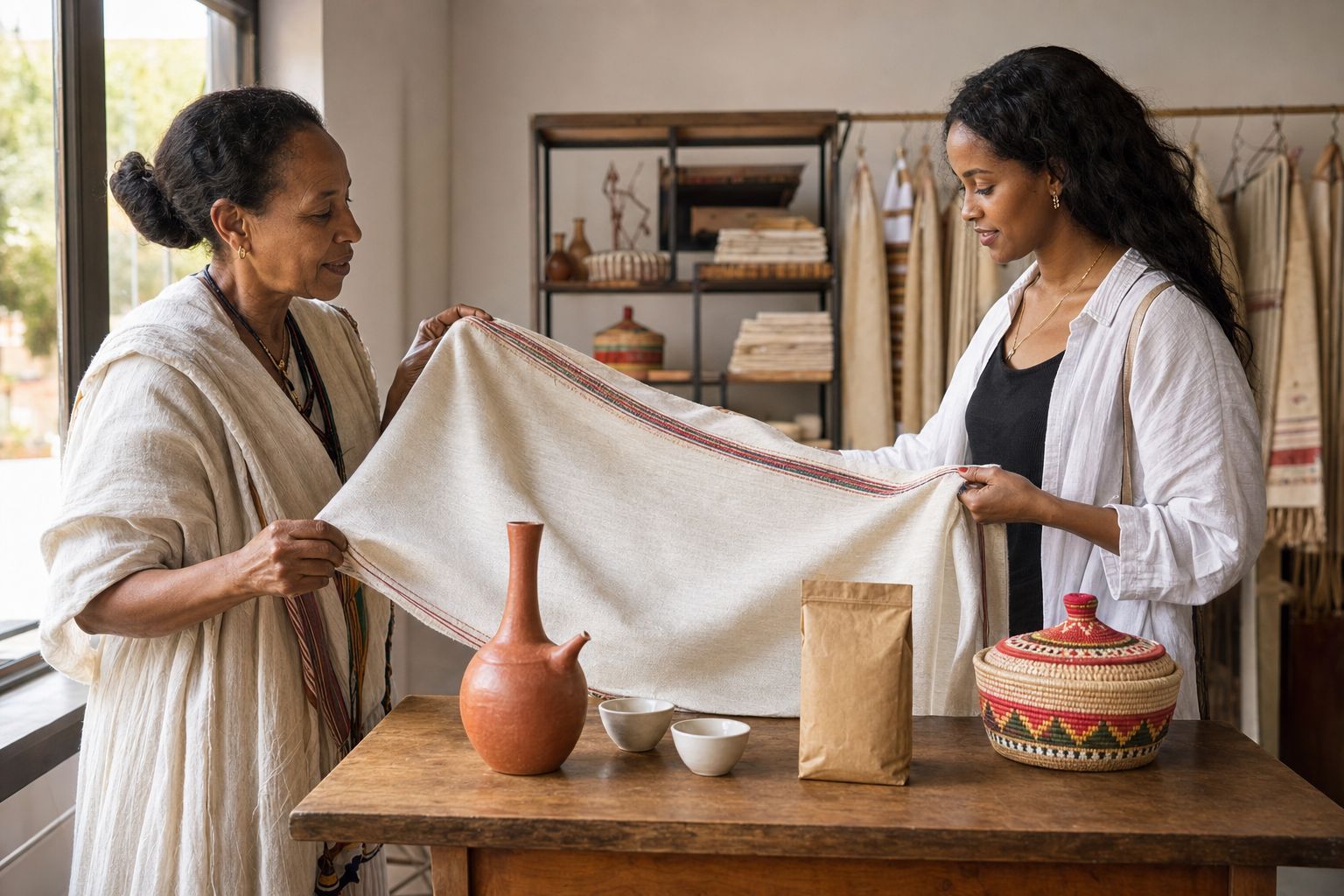
An illustrative artisan shop with a woven shawl, coffee pot, cups, coffee bag, and lidded basket.
A good souvenir should survive the journey and still mean something after the trip. That usually points toward an item with a clear maker, useful material, and honest story. It does not require a certificate claiming that every pattern is ancient or every object is unique.
Ethiopia offers excellent textiles, coffee, pottery, baskets, spices, leatherwork, jewellery, books, and contemporary art. The safest approach is to buy new work from a reputable maker or shop, ask simple questions, keep the receipt, and avoid anything presented as an antique or sacred object without proper documentation.
Use three questions before buying
Ask:
- Who made it?
- What is it made from?
- Can I legally and safely take it home?
A seller may not know every detail, but a clear answer about material and production is more useful than a dramatic claim. Be careful with phrases such as museum quality, ancient, tribal, or blessed when no evidence is offered. An ordinary new object made well is a better purchase than an uncertain old one.
Also think about the person receiving it. Coffee is useful for someone who brews it. A large mesob is meaningful but difficult to transport. A shawl fits many people more easily than a tailored dress.
Handwoven textiles
Textiles are among the easiest Ethiopian crafts to use at home. Options include a netela or other light shawl, a scarf, table linen, cushion covers, and fabric intended for tailoring. Names and styles vary by language, community, and seller, so ask rather than assuming every white cloth is the same garment.
Look closely at:
- The evenness of the weave
- The strength of seams
- Loose threads around decorative bands
- Colour transfer when gently rubbed with a clean white tissue
- The fibre content
- Care instructions
Handmade does not mean perfectly uniform. Small changes can show the human process. Damage is different. A split seam or decoration pulling away from the base cloth will not improve in your suitcase.
If a seller describes a pattern as belonging to a particular region or community, ask how they know. Do not repeat a regional meaning as fact until it is confirmed with the maker or a reliable cultural source.
Coffee for a gift that will be used
Packaged Ethiopian coffee is compact and practical. Choose a sealed bag from a roaster or seller that provides the roast date, bean form, weight, and origin information you need. The label should be legible and the seal intact.
Ask whether the recipient uses whole beans or ground coffee. Ground coffee is convenient but loses aroma faster once opened. Whole beans require a grinder.
Avoid treating a region name as a guarantee of flavour. Processing, roast, freshness, storage, and brewing all matter. If tasting is available, choose what you actually like instead of buying only the most famous name.
No reliable universal rule sets a specific quantity limit for coffee that a traveler can carry, and sealed roasted coffee is not necessarily treated the same as raw beans or seed. Keep it in the original sealed package with your purchase receipt, and check both Ethiopia’s export rules and the food import rules of your destination country directly for the specific product and amount before you fly.
A jebena and small coffee cups
A jebena is the clay pot used in Ethiopian coffee preparation. Its round body, narrow neck, and spout make it visually distinctive, but it is also fragile. New pots range from simple working pieces to more decorative versions.
Check for visible cracks, especially around the neck and spout. Place the pot on a flat surface to see whether it sits steadily. Ask whether it is intended for use or decoration and how it should be prepared before first use.
Small handleless coffee cups, often called sini, are easier to pack. Buy them as individual useful objects rather than assuming a particular number has a universal ceremonial meaning.
Wrap the spout separately, fill the hollow body with soft material, and place the pot inside a firm box surrounded by clothing. Carry it in hand luggage only if airline security and baggage rules permit, and check the current pottery packing and cabin allowance with the airline before you rely on it.
Woven baskets
Ethiopian basketry includes lidded containers, trays, small boxes, and the large mesob used as a table or serving surface. Materials, forms, and patterns differ across makers and communities.
For travel, a small lidded basket is usually easier than a full mesob. Check that the lid fits, the base sits flat, and the fibres are dry and clean. Natural materials can be affected by moisture, crushing, and destination biosecurity rules.
Do not force a woven piece into a smaller suitcase. Place light clothing inside it, protect the rim, and stop heavier luggage from pressing on the lid. Ask the airline about oversize items before buying a large piece.
Spices and cooking ingredients
Berbere, mitmita, shiro powder, and other dry cooking ingredients can bring a familiar taste home. Buy sealed, clearly labelled packages from a source you trust. An unmarked bag may be normal in a local market, but it is harder to identify at customs and harder for the recipient to use safely.
Check the ingredients. Berbere is a blend, not a single fixed recipe, and heat varies. Mitmita can be much hotter. Ask how the seller expects it to be used, then write that advice down.
As with coffee, there is no reliable universal quantity limit for spices, shiro, or other packaged cooking ingredients. Do not assume a sealed retail package is automatically exempt from rules that apply to raw ingredients. Plants and related material can also require a phytosanitary certificate depending on the destination country, and commercial seed exports carry additional requirements. Do not pack fresh leaves, seeds for planting, raw animal products, or unlabelled powders without checking both Ethiopian export rules and your destination country’s import rules for the specific product and amount.
Leather goods and jewellery
New leather bags, belts, shoes, and small cases can be useful gifts. Inspect stitching, lining, fasteners, and dye transfer. Ask what animal the leather came from and whether any export documentation is required.
Jewellery ranges from contemporary silver work to pieces inspired by religious or regional forms. Buy new work with a receipt. A cross shaped pendant sold as modern jewellery is different from an old religious artefact. If an item is claimed to be antique, historic, excavated, or previously used in worship, do not assume an ordinary shop receipt is enough.
Ivory must be avoided entirely. Wildlife products and some animal skins may require permits or be prohibited, so check the current rules with customs authorities before you buy anything made from animal material.
Books, music, and contemporary art
A book from an Ethiopian publisher, a legally produced music recording, or a print purchased directly from an artist can be a thoughtful souvenir. Check the language and format before buying. A book in Amharic script may be beautiful, but it is more useful when the recipient understands what it is.
Avoid copied recordings, reproduced paintings, or printed designs that give no credit to the creator. Ask whether a print is authorised and whether the artist is identified. If buying original art, request a receipt and confirm any export requirement, especially when the work is old or uses unusual materials.
What not to buy casually
Do not casually purchase:
- Objects claimed to be antiques
- Old manuscripts or manuscript pages
- Religious objects presented as historic
- Excavated pieces
- Ivory in any form
- Unidentified animal skin, horn, feathers, or other wildlife products
- Fresh plants, seeds, or unlabelled biological material
Buy newly made commercial souvenirs from established sellers, and keep an itemized receipt that states the item is new or sold as a tourist souvenir. An object that could be mistaken for an antique, an authentic religious object, a wildlife product, or a cultural heritage object may require a permit, and it can be confiscated whenever its status is unclear, even if you bought it in good faith. Exporting a protected antique or cultural object without the required certificate can lead to confiscation or prosecution.
Authentic religious objects, including some Ethiopian crosses, may count as protected heritage even when the seller calls them an ordinary souvenir. A cross made and sold as new jewellery is a different purchase from one presented as old or previously used in worship, and only the seller’s word usually separates the two. Ask directly, and treat any uncertainty as a reason to choose a clearly new piece instead.
Export, sale, or transfer of wildlife products, processed or unprocessed, requires a permit. Avoid ivory entirely in any form.
If the seller says an item is old but promises that nobody checks, leave it. The risk includes confiscation, fines, legal trouble, and harm to cultural heritage.
Buy in a way that respects the maker
Some shops use fixed prices. Markets may allow negotiation. Ask once, keep the conversation friendly, and decide what the object is worth to you. Aggressive bargaining over a handmade object can erase the value of hours of work.
Ask for a receipt showing the shop, date, item, and amount. If the object is represented as handmade or made in a particular place, ask the seller to include that description when possible. Documentation does not prove every cultural claim, but it helps show that you bought a new commercial item openly.
A packing check before payment
Imagine the item inside your real luggage:
- Will it fit without bending?
- Can it handle pressure?
- Does it contain liquid, powder, soil, seeds, or animal material?
- Is the package sealed?
- Will security need to inspect it?
- Do you have a receipt?
- Have you checked the destination country’s import rules?
Take a photograph of fragile items before the shop wraps them. If a seller ships internationally, ask about tracking, insurance, customs declarations, and responsibility for damage before paying.
The best Ethiopian souvenir is not necessarily the rarest. A new shawl from a skilled weaver, a coffee bag you tasted, or a small basket from its maker carries a more honest connection than an object with an uncertain story.