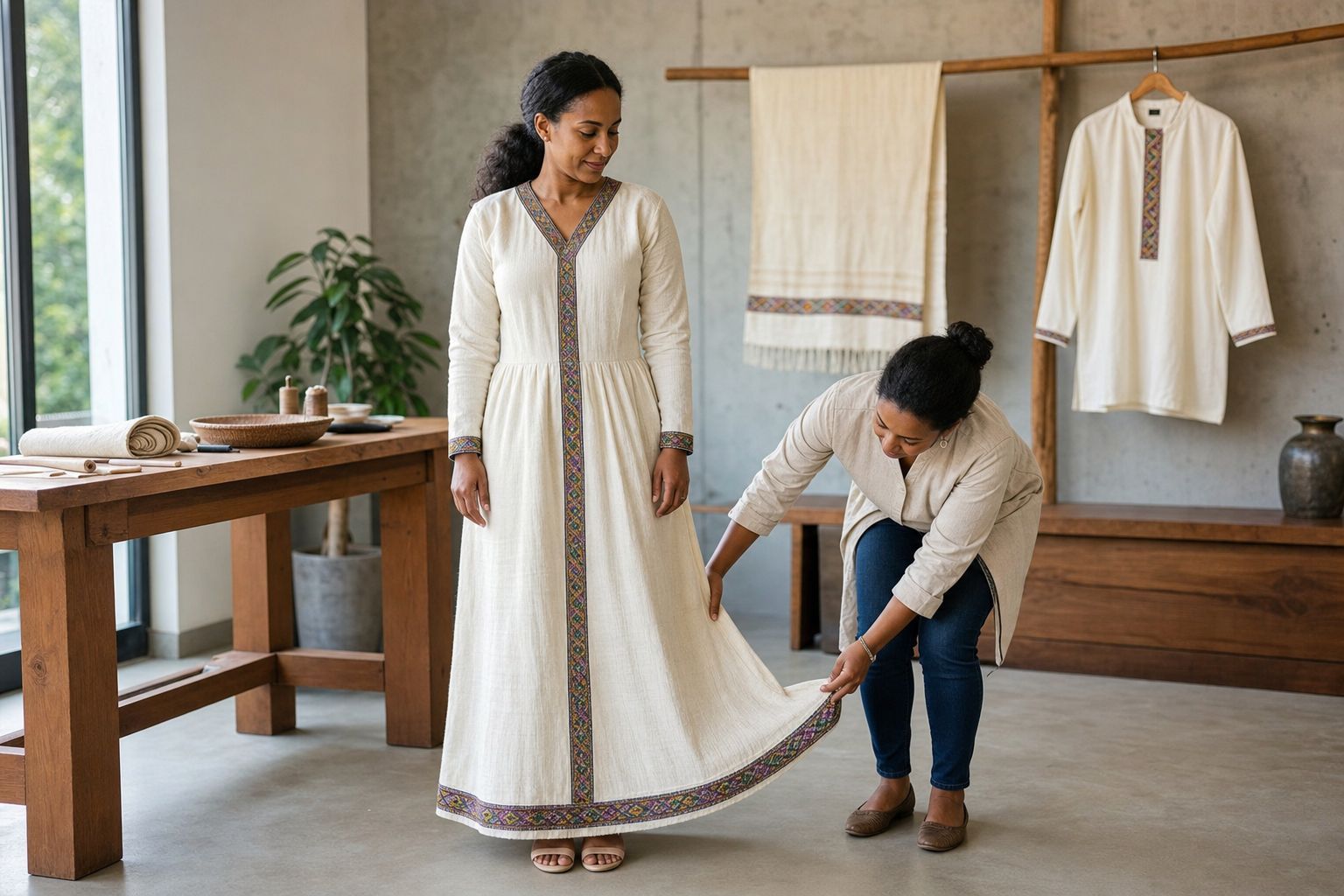
An illustrative atelier scene showing a white woven dress with coloured decorative bands.
The white dress with a coloured border is one of the most recognisable images of Ethiopian clothing. It is also only one part of the story. Ethiopia is home to many peoples, and clothing changes with community, location, climate, religion, age, occasion, and personal taste.
Calling one garment the Ethiopian traditional dress can therefore hide more than it explains. A better starting point is to ask which garment, whose tradition, who made it, and when it is worn.
Why the plural matters
Traditional clothes are not a frozen national uniform. People in northern and central highland communities may share some handwoven cotton practices while using different names, designs, and ways of dressing. Oromo clothing varies across a very large population and geography. Somali, Afar, Harari, Sidama, Wolaita, Gurage, Gamo, Konso, and many other communities have their own histories and present day styles.
Religion also matters. Clothing for an Ethiopian Orthodox service may differ from clothing for a Muslim wedding, a Protestant celebration, a local cultural festival, or an ordinary family gathering. Urban fashion designers now combine handwoven fabric with modern cuts, and diaspora communities adapt garments for new settings.
No single article can catalogue all of this responsibly. It can show how to look, ask, and avoid turning one group’s clothing into a claim about everyone.
The handwoven white cotton tradition
White or off white handwoven cotton clothing is widely visible in Ethiopia, especially in highland cultural and religious settings. Museum collections document dresses made from Ethiopian cotton woven on treadle looms, with decorative work around the neck, sleeves, centre, or hem.
The cloth is often described as shemma. Narrow woven lengths can be joined to create a wider garment or shawl. Fine fabric may feel airy and slightly transparent, while heavier cloth is used for warmer wraps.
The long women’s dress commonly called a habesha kemis is part of this tradition. Kemis means dress in Amharic, while habesha is an identity term whose use and boundaries are not accepted in exactly the same way by everyone. In some contexts, zuria is another term used for a dress. Terminology like this is worth checking with the specific maker or community you are describing rather than treating it as fixed across the whole country.
The coloured bands may be woven, embroidered, or made with a mixture of techniques. Terms such as tibeb and tilet are used by sellers and wearers, sometimes with different meanings. A decorative band should not automatically be assigned a symbolic message. It may indicate a recognised local design, a designer’s choice, a family preference, or simply a colour combination the wearer likes.
Shawls and wraps
A light white cotton shawl is often called a netela in Amharic. It may be worn around the shoulders, drawn over the head in a religious setting, or arranged differently for comfort and style. The decorative edge can be displayed or kept subtle depending on the occasion and wearer.
Heavier wraps include garments commonly called gabi. A gabi is useful in cool highland weather and may be worn by men or women. Other terms, including kuta, can refer to lighter wraps in some contexts. These words should be checked locally rather than treated as exact labels across every community.
How a cloth is wrapped can matter as much as the cloth itself. Copying a style from a photograph without understanding its setting can create an awkward result. If you are attending a service or ceremony, ask the host how the garment is normally arranged.
Men’s clothing
Men’s traditional clothing also differs by community and event. In some highland settings, a man may wear a white woven shirt or long tunic, white trousers, and a shawl or heavier wrap. Decorative woven or embroidered bands may appear at the collar, front opening, cuffs, or edge of a shawl.
That description should not be turned into a national rule. Men also wear suits, regional garments, religious clothing, military influenced ceremonial dress, and modern designs using traditional fabric. At a contemporary wedding it is common for one person to change between a suit and woven clothing, or to combine elements.
Regional identity cannot be read from one border
Online posts often label a colour or motif as Oromo, Amhara, Tigrayan, Gurage, or another identity without evidence. That is risky. Designs travel through markets, marriage, migration, trade, tailoring, and fashion. A motif used by one community may also appear elsewhere, while a modern designer may create something new from several references.
Museum records can help with a documented object. For example, the Museum of Anthropology at the University of British Columbia identifies one dress through its collected history and an oda tree motif associated with Oromo design. That does not mean every tree pattern or every similar dress carries the same identity.
When accuracy matters, ask:
- What is the garment called in the wearer’s language?
- Who made it and where?
- Is the design associated with a particular place or community?
- Is that association traditional, recent, or a designer’s interpretation?
- Is it worn for a specific event?
If the answer is uncertain, describe what is visible rather than guessing identity.
What clothing can communicate
Clothing may express several things at once.
Occasion: A carefully finished dress, shawl, or tunic may be chosen for a wedding, holiday, graduation, religious service, baptism, or formal family event.
Faith and modesty: A shawl can serve a practical and religious purpose. Expectations differ across churches, mosques, families, and local communities.
Craft: Handspun or handwoven cotton, careful joining, and decorative work represent labour and skill. The quality of the cloth may be part of the garment’s value even when the design has no fixed symbolic code.
Belonging: A person may wear a garment to honour family, language, place, or heritage. The same person may also choose it because it is comfortable or beautiful.
Modern taste: New silhouettes, brighter thread, metallic detail, fitted bodices, and mixed fabrics show that tradition continues to change. New does not automatically mean inauthentic.
Meaning comes from context and the wearer’s explanation. A chart claiming that every colour has one Ethiopian meaning is not reliable.
Climate and material
Ethiopia’s geography moves from cool highlands to hot lowlands. Clothing responds to temperature, work, available fibre, trade, and local ideas of modesty. A heavy gabi makes sense on a cold Addis morning but not as a general answer for every region.
Cotton is central to many documented woven garments, yet modern clothes may include rayon, silk, metallic thread, synthetic fibre, factory cloth, or imported material. Ask what the garment contains before buying or cleaning it. Appearance alone does not prove that a piece is fully handwoven or made from pure cotton.
When visitors wear Ethiopian clothing
Visitors and members of the diaspora often want to wear Ethiopian clothing at weddings, holidays, cultural events, or religious services. The respectful route is simple: ask the host, name the garment accurately, and avoid claiming an identity that is not yours.
At a religious site, modest coverage and a correctly arranged shawl may be more important than elaborate decoration. At a wedding, the family may request a colour or style. At a cultural celebration, a garment linked to one community should not be relabelled as a costume from another.
Do not treat a person in traditional clothing as a public exhibit. Ask before taking a close photograph. A public event does not remove an individual’s right to refuse.
How to buy with useful questions
Begin with the maker or seller:
- Is the cloth handwoven, machine woven, or mixed?
- Is the decoration woven into the cloth or added later?
- Where was it made?
- Is the garment ready made or tailored?
- What measurements are needed?
- How should it be washed and stored?
- Does the seller identify the design with a particular community, and on what basis?
Check seams where narrow panels join. Look at the inside of decorative work. Test whether a shawl edge lies flat. For a dress, move your shoulders, sit down, and walk before accepting the fit.
Prices, tailoring time, and which markets in Addis Ababa are worth visiting all change, so ask a few sellers directly rather than relying on a fixed figure.
Care depends on the actual garment
Do not assume every white cotton garment can be washed the same way. Metallic thread, coloured rayon, lining, embroidery, and delicate joins may need different care.
Ask the maker for written instructions. If none are available, test a hidden area before using water or detergent. Store the garment clean and dry, away from direct sun. Fold decorative bands loosely rather than pressing the same line repeatedly.
For an older family garment, consult someone experienced with the textile before cleaning it. Age can weaken thread even when the cloth looks strong.
The most honest way to describe what you see
If you know the garment’s name, community, maker, and occasion, include them. If you do not, use a visual description: a white handwoven cotton dress with a coloured border, worn at a family celebration. That sentence is less dramatic than an invented cultural meaning, but it is far more respectful.
Ethiopian clothing is worth understanding in detail. The detail begins with listening to the people who make and wear it.