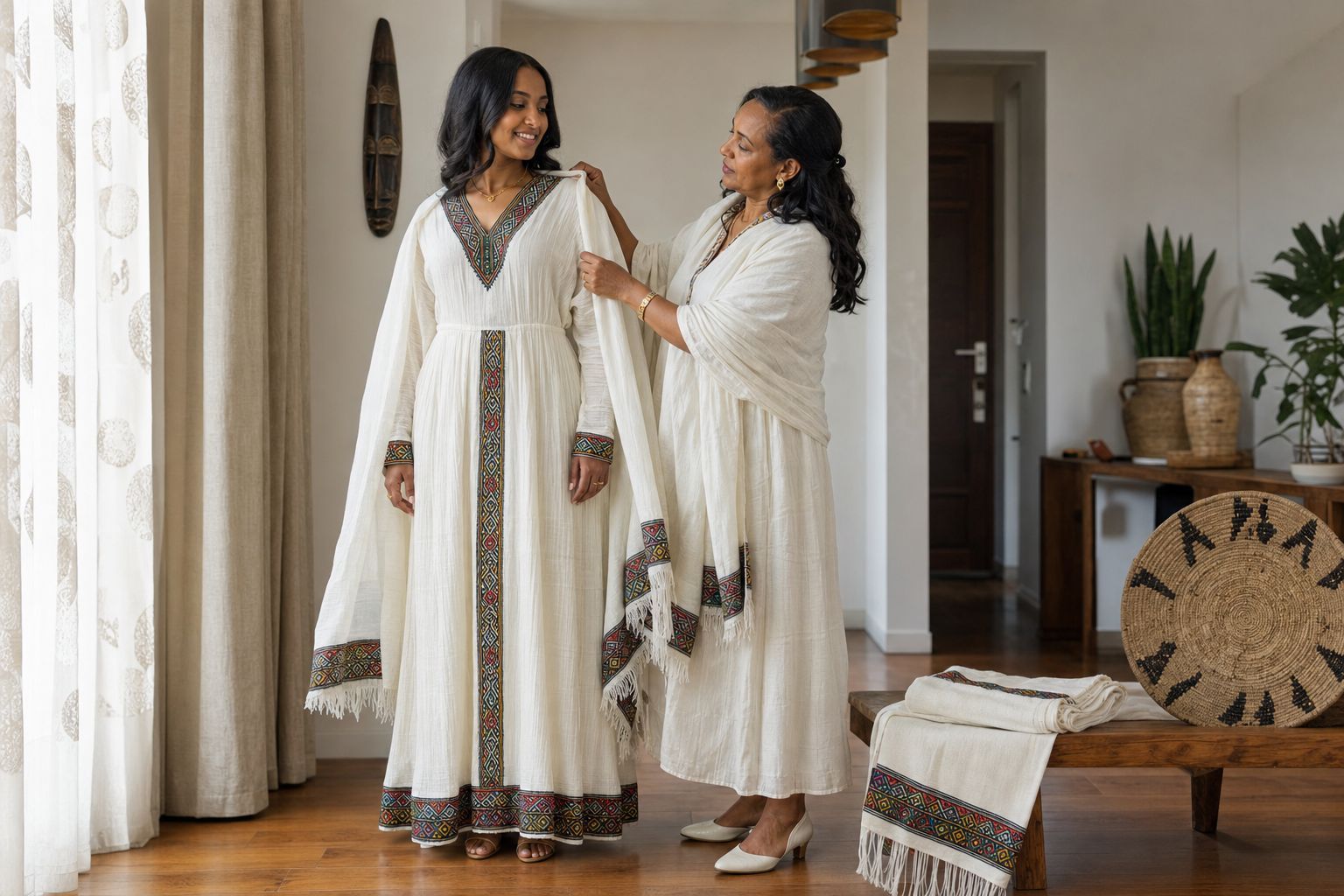
An illustrative family scene with a white kemis, woven decorative bands, and a matching shawl.
A habesha kemis can look simple from across a room: a long white dress, a clean line, and a band of colour. Up close, the decisions multiply. The cloth may be fine or heavy. Decoration may be woven into a panel or added with embroidery. The neck, sleeves, waist, hem, and shawl can all change the final character.
The garment is broadly associated with Ethiopian and Eritrean highland dress traditions, but naming and identity are sensitive. Any more specific claim about which individual communities the term or the garment belongs to needs a dress history source or a local cultural expert behind it rather than being stated as settled fact. It should not be used as a label for every traditional dress in Ethiopia.
What the name means
Kemis means dress in Amharic. Habesha is a cultural identity term used in different ways by different people. Some use it broadly for northern Ethiopian and Eritrean highland communities. Others prefer a more specific identity or avoid the term.
In everyday shops, habesha kemis often means a long white or off white women’s dress made from, or inspired by, handwoven cotton cloth. The term zuria is also used for some dresses. The exact terminology and spelling shift between makers and wearers, so it is worth asking the person you are buying from how they use the words rather than assuming one fixed version.
The useful question is not only whether a dress is called habesha kemis. Ask what cloth it uses, where the design comes from, how it was made, and what occasion it suits.
The cloth comes first
Many kemis are made from cloth described as shemma, traditionally woven in narrow lengths and joined. The finished fabric can be soft and airy, with the subtle irregularity of handwork. A denser weave gives more coverage and structure.
Cotton is central to documented examples. Modern dresses may also contain rayon, silk, metallic thread, synthetic fibre, lining, or machine made cloth. A bright decorative band does not prove that the base fabric is handwoven.
Look for the joins. On a well made garment, panels support the shape rather than pulling it out of line. The inside seams should be secure. Fine cloth may need a slip or lining, but heavy lining can change the way the dress moves.
Decorative bands and changing vocabulary
Coloured work may run around the neck, down the centre, across the cuffs, and around the hem. Sellers may call this tibeb, tilet, or another local term. The words are not always used consistently.
Some decoration is woven as part of the textile. Some is embroidered. Contemporary designers may add applique, beads, metallic thread, or machine work. Ask which technique was used instead of judging from a photograph.
Pattern names and meanings also require care. A seller may connect a border to a place, faith, or community. That connection should be confirmed before it becomes a caption or cultural claim. A modern geometric band can be chosen for beauty without carrying a fixed message.
What can be said about its history
Museum collections provide useful evidence because they document real objects. The British Museum holds a contemporary Ethiopian cotton dress made in 1993, with handwoven cloth and decoration around the hem, neck, arm openings, and centre. Its curatorial note connects such dresses to earlier special occasion clothing while also identifying modern materials.
The Powerhouse collection holds a habesha kemis and netela from the twentieth century. The record notes both handwoven cloth and embroidery. These objects show continuity in white cotton, decorative borders, and matching shawls. They also show change.
It is safer to say that the modern kemis draws on long standing highland weaving and dress practices than to give it one exact birthday or inventor. Claims that a single modern design has remained unchanged for thousands of years should be treated cautiously.
Common style choices
There is no one correct silhouette. A kemis may be loose and column shaped, gathered at the waist, fitted through the bodice, or cut with a fuller skirt.
Details to compare include:
- Round, V shaped, square, or raised necklines
- Long fitted sleeves, wider sleeves, or shorter modern sleeves
- Decoration only at the edges or a strong central panel
- A loose waist, gathered waist, or separate belt
- A narrow hem band or a deeper decorative border
- A matching netela, contrasting shawl, or no shawl
A photograph can make a heavy dress appear light and flowing. Ask to touch a fabric sample and see the garment move. If buying online, request exact measurements and a close view of the inside seams.
When people wear it
A habesha kemis is often chosen for weddings, religious holidays, church, graduations, baptisms, cultural events, family celebrations, and formal gatherings. It can also be worn simply because the wearer likes it.
The appropriate design depends on the setting. A highly decorated fitted dress may suit an evening wedding. A modest neckline with a shawl may be more comfortable for a religious service. Family preferences matter, and a wedding host may request a colour or level of formality.
Do not assume that every white dress is church clothing or every colourful design is a wedding dress. Ask the wearer.
Wearing the netela
A netela is a light woven shawl commonly paired with the kemis. It can sit on the shoulders, wrap around the upper body, or cover the head in some religious settings. The decorative edge may face outward or be arranged more quietly.
There is no single arrangement for every event. A relative, host, or experienced dresser can show the expected style. This is better than copying an image that may come from a different community or ceremony.
The shawl should stay secure without constant adjustment. If it slides, ask about a discreet pin or another arrangement that will not damage the cloth.
Getting the fit right
Take measurements over the undergarments or slip that will be worn with the dress. A tailor may need:
- Shoulder width
- Bust
- Waist
- Hip
- Upper arm
- Sleeve length
- Shoulder to waist
- Full dress length with the intended shoes
Ask how much ease the design includes. A dress that fits while standing may pull when sitting or dancing. Raise both arms, sit, turn, and walk during a fitting.
Check that the central decoration is actually centred and that the hem hangs evenly. If the cloth is delicate, repeated alterations can leave visible needle marks, so agree on the fit before final finishing.
Tailoring time and the fitting schedule vary by workshop and season, so confirm both directly with the tailor before you count on a date.
Handwoven, machine made, and mixed work
These categories are not a simple quality ladder. Handwoven fabric carries skilled labour and distinctive texture. Machine made cloth can be more uniform, easier to care for, and less expensive. Many garments combine the two.
Ask the seller to describe each part accurately. If the price is based on handwork, the maker should be able to explain where that work appears. Look at the reverse of embroidery and the edges of woven bands.
A high price does not automatically prove authenticity. A low price does not always mean poor work. Judge the construction, material, fit, and honesty of the description.
Buying in Addis Ababa
Shiro Meda is a genuine, well known market in Addis Ababa for traditional textiles, clothing, and handicrafts. Designers and tailors also work in other neighbourhoods, and some sell online. What this article cannot responsibly give you is a current price. No reliable, current data on typical Shiro Meda prices was found while researching this guide, and a single boutique’s list price is not the same thing: as one example, Lewam Chiffon, a Bole and CMC based boutique rather than a Shiro Meda stall, currently lists generic women’s chiffon pieces around 13,000 to 14,000 birr and one item labelled Traditional Ethiopian Dress at 26,000 birr at its own locations. That figure belongs to one boutique, not to the market as a whole, and it should not be read as a guide to what a Shiro Meda tailor or stall would charge. The names of two or three specific sellers, their real current prices, and details such as deposit size, number of fittings, and completion time genuinely need an in person check in Addis Ababa. That is not something this article can answer from a desk.
Before paying a deposit, write down:
- The agreed fabric
- The design and decoration placement
- Measurements
- Lining
- Shawl inclusion
- Total price
- Deposit
- Fitting dates
- Completion date
- Alteration policy
Use photographs as a reference, but do not ask a tailor to copy another designer’s protected work exactly. Discuss the features you like and create a distinct version.
Can a visitor wear one?
Many visitors are welcomed when they wear Ethiopian clothing respectfully at a celebration. The host’s view matters more than a general internet answer. Ask what level of formality is expected and whether the chosen design has a specific community or religious association.
Do not describe yourself as belonging to a culture simply because you are wearing its clothing. Credit the maker when sharing photographs. At a church or ceremony, follow local photography rules and do not turn worshippers into a background for a fashion shoot.
Cleaning and storage
Care depends on the fibre, dye, lining, and decoration. Ask the maker before washing. Metallic and rayon thread may react differently from cotton, while some colours may run.
If written instructions are unavailable:
- Test a hidden section first.
- Avoid harsh bleach on coloured decoration.
- Do not twist delicate cloth.
- Dry away from strong direct sun.
- Store only when completely dry.
- Fold with clean tissue around raised decoration if needed.
For an older or valuable garment, use a textile specialist rather than experimenting.
Choosing well
The best kemis is not the one with the most decoration. It is the one whose material is honestly described, whose fit allows the wearer to move, and whose design suits the occasion.
Learn the maker’s name. Ask about the cloth. Confirm the garment’s cultural description before repeating it. That attention gives the dress more respect than a dramatic but uncertain history.