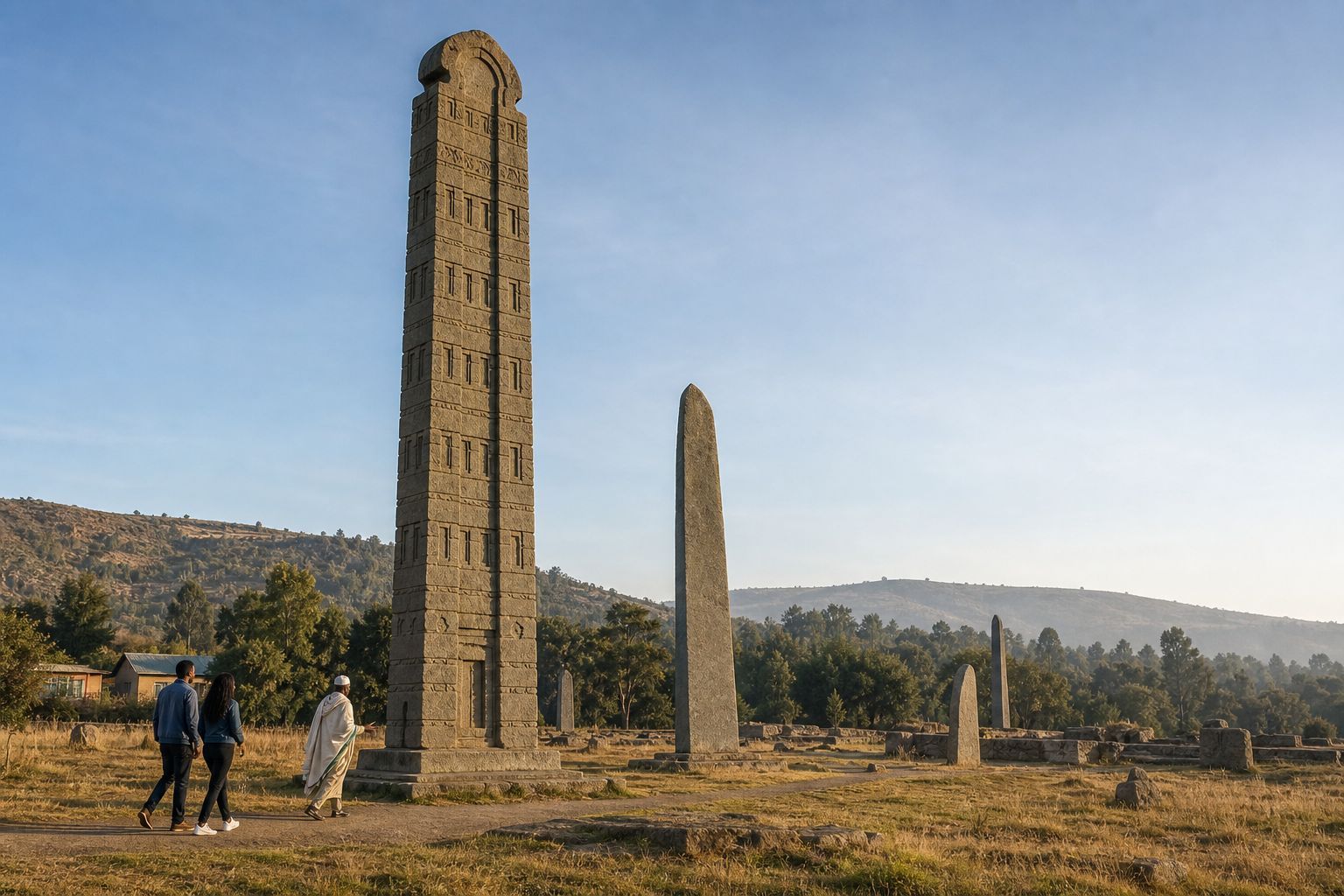
 The carved stelae at Aksum imitate architectural forms and connect to an ancient royal burial landscape.
Axum is a modern town built around the remains of an ancient capital. Tall stelae rise close to roads and homes. Archaeological areas sit near active churches. Stories about kings, trade, conversion, burial, and sacred objects overlap in the same compact landscape.
The spelling varies. UNESCO uses Aksum for the World Heritage property, while many English travel searches use Axum. This guide uses Axum for the destination title and Aksum when referring to the ancient kingdom or official property name.
The ruins represent a civilization that connected the northern Ethiopian highlands with the Red Sea world. UNESCO describes the Aksumite kingdom as a major power from roughly the first to the eighth centuries. The wider archaeological record and the city’s religious importance continue beyond those dates.
For comparison with other periods and regions, see Best Historical Places to Visit in Ethiopia.
Current safety and access note
Read this before anything else. As of 6 August 2026, Axum is not a place most travellers can visit as an ordinary leisure trip, and this guide should not be read as a bookable itinerary right now.
Axum sits in Tigray Regional State. The United Kingdom’s current advice tells everyone, not only official travellers, not to go to Tigray at all. The United States’ current advisory, dated 1 April 2026, rates the whole country Level 3, Reconsider Travel, and separately tells the public not to travel to Tigray among several other regions. This is a public warning aimed at ordinary visitors, not a rule limited to government staff.
Civilian flights to and from Tigray have been suspended since 29 January 2026, according to the UK Foreign Office. If any part of this article, an old booking page, or a tour operator implies daily or routine flights to Axum, treat that claim as unconfirmed until you see it stated by the airline itself, close to your travel date. There is also no responsible road alternative. Areas along overland routes into Tigray fall under the same severe warnings, so a land route is not a safe workaround for a flight suspension, and this guide does not present one.
These conditions change quickly and can tighten or ease with little notice. Check your own government’s live travel advice before booking anything, not just whether a tour operator has availability or a flight shows as bookable online.
Right now, this article’s purpose is to help you understand Aksum’s history and plan for a future visit, not to describe a trip you can take this month. Museum hours, the entrance ticket price, photography rules, and access to specific tombs or outer sites are not verified here and should not be treated as current until confirmed at the time of a real, safe visit.
Why ancient Aksum mattered
Aksum developed at a crossroads linking inland Africa, the Red Sea, Arabia, and wider trade networks. Its rulers issued coins, commissioned monumental stelae, and left inscriptions in several languages. The kingdom adopted Christianity in the fourth century, a change visible in coinage and central to later Ethiopian history.
The city remained symbolically important after its political decline. Ethiopian rulers continued to connect their legitimacy with Aksum, and the church complex of Saint Mary of Zion remains one of the country’s most sacred Christian places.
Archaeology and faith meet here, but they should not be blurred. Coins, inscriptions, tombs, and building remains can be studied as material evidence. Beliefs about the Ark of the Covenant belong to a living religious tradition. A visitor can respect both without claiming that one proves every detail of the other.
How do I get there
In ordinary times, Axum is reached from Addis Ababa by air or by a long road journey, roughly 1,024 kilometres if you route through Mekelle or about 1,180 kilometres if you route through Gondar. Those figures come from the Ethiopian tourism ministry’s own orientation material and are useful only as geographical context. They are not an endorsement of driving either route today.
Civilian flights to and from Tigray have been suspended since 29 January 2026, and the roads into the region fall within areas under a do not travel warning. There is currently no dependable, safe way to reach Axum for ordinary tourism. When conditions genuinely change, confirm the flight directly with the airline, and confirm road safety with your own government’s advisory and a trusted local source, rather than relying on a distance figure or an old itinerary to judge whether the journey is realistic.
Start with the northern stelae field
The northern stelae field provides the clearest introduction to Aksumite monument building. The largest standing carved stelae imitate a tall building through false doors, windows, beams, and storeys. Their scale can distract from the surrounding ground, where tombs and other archaeological features explain their funerary context.
One enormous stele lies broken. Its position and fragments help visitors see the difficulty of quarrying, moving, raising, and stabilizing such stones. Do not climb or sit on the fragments.
The returned and reerected stele also carries a modern history. Italian forces removed it in the twentieth century. It was returned from Rome and raised again in Aksum after a long process. A guide should explain the dates and conservation work accurately, and confirm current access around any conservation zones along with the interpretation the site authority currently provides.
Tombs and underground spaces
Several tombs near the stelae field reveal stone construction below ground. Names such as the Tomb of the False Door and Tomb of the Brick Arches are commonly used in visitor routes.
Access can change because of structural safety, water, conservation, or staffing. Never enter a closed passage or step beyond a barrier. Stone floors can be uneven and dark, so a small light may help if permitted.
The tombs add necessary context. Without them, the stelae can look like free standing monuments with no connection to burial and status. Take time to see how the field, monuments, and underground structures relate.
The archaeological museum
The local archaeological museum can bring together objects that are difficult to understand in the open landscape, including ceramics, inscriptions, coins, and architectural fragments. Confirm that it is open before you go, where the current entrance is located, which collections are on display, and whether photography is permitted.
Read labels carefully but ask a guide where interpretations have changed. Archaeological dating and attribution can be revised as research develops.
Saint Mary of Zion
The Saint Mary of Zion church complex is central to Ethiopian Orthodox belief and national history. Different church buildings stand within the wider sacred area, including a modern cathedral and older structures associated with the Gondarine period.
Tradition holds that the Ark of the Covenant is kept in a guarded chapel. Visitors should not expect to enter that chapel or see the sacred object. Claims that a special payment, personal request, or unofficial contact can provide access should be rejected.
Church access rules may differ for men and women and may change during services or festivals. Dress modestly, remove shoes where required, and follow clergy instructions. Ask before photographing any worshipper, priest, manuscript, cross, or interior.
Inscriptions and royal remains
The Ezana Stone is often compared with the Rosetta Stone because its inscriptions use multiple languages or scripts. The comparison can help a beginner understand why it matters, but the objects belong to different historical settings and should not be treated as equivalents.
Royal remains and sites outside the central field may include structures commonly called the Palace of the Queen of Sheba or associated with kings such as Kaleb and Gebre Meskel. Some popular names come from later tradition rather than secure archaeological identification.
Use careful wording:
- Say a site is traditionally associated with a figure when the identification is not certain.
- Ask what excavations actually found.
- Avoid turning the Queen of Sheba into a simple photo theme.
- Distinguish a local name from a proven historical function.
How long to stay
Two nights allow a useful first visit when travel is safe. Use the first full day for the stelae field, tombs, museum, inscriptions, and church area. A second day can cover selected outer sites at a slower pace.
Three nights are better if Yeha can be reached safely and is open. Yeha belongs to an earlier historical context and deserves time for its own temple remains, museum, and church setting. Do not add it to an itinerary until you have checked road security, transport, opening status, and regional travel advice for the time you plan to go.
A flexible two day route
Begin the first morning at the stelae field before the strongest midday heat. Continue to open tombs and the museum. After lunch and rest, visit the Ezana Stone and approach the Saint Mary of Zion complex with enough time to follow church rules rather than rushing.
On the second day, use an authorized guide and vehicle for outer archaeological sites that are officially open. Return to the central area for any museum or church component missed on day one.
The route must remain flexible. Worship, funerals, conservation work, staffing, weather, and security can change access without warning.
Guides, tickets, and practical checks
An authorized local guide is valuable because the landscape combines archaeology, oral tradition, and active religion. Agree on the route, duration, and fee before starting, and confirm the current site ticket, guide system, museum fee, church contribution, camera rules, and opening hours directly rather than relying on an old online price list.
Keep official receipts. If separate sites collect separate charges, ask what each payment covers. Do not pay unofficial intermediaries for access to protected or sacred areas.
Walking, weather, and altitude
Axum sits in the northern highlands. Sun can be strong while mornings and evenings feel cool. The archaeological route includes exposed ground, stone steps, and uneven surfaces.
Wear closed shoes, carry water, and use sun protection. A light warm layer helps outside midday. Rain can make soil and stone slippery.
Altitude can affect travellers arriving from low elevations. Plan a moderate first day, drink water, and seek medical advice before travel if you have a relevant health condition.
Visitors with limited mobility should ask which tombs and fields are accessible. Underground spaces and rough paths may not be suitable, even if the main stelae view can be reached.
Respectful photography
Stelae and wide archaeological views can be photographed from established paths unless current rules say otherwise. Churches, worshippers, manuscripts, and sacred objects require more caution.
Do not use flash on old surfaces. Do not climb for a higher view. Do not photograph security facilities, checkpoints, or military activity.
The generated hero in this draft is an illustration. A real authorized image should replace it before publication if possible, because accuracy matters at a specific archaeological site.
Common mistakes
- Seeing only the tallest stele and leaving
- Ignoring the tombs and burial context
- Presenting traditional site names as proven archaeology
- Demanding to see the Ark of the Covenant
- Photographing inside churches without permission
- Adding Yeha without checking the road and current safety
- Publishing old museum hours and fees
- Climbing monuments or entering closed tombs
- Assuming a hotel booking means regional access is safe
- Using Aksumite, medieval, and modern history as if they were one period
What a good visit should leave you with
Axum is not important because one monument is tall. Its significance comes from the complete landscape: stelae and tombs, inscriptions and coins, an ancient state and later memory, archaeology beside continuing worship.
When travel becomes safe again, allow enough time to compare those layers. Use a guide who can say when evidence is firm and when a story belongs to tradition. Follow church limits without treating them as obstacles. The result is a more honest picture of Aksum’s place in Ethiopian and Red Sea history.