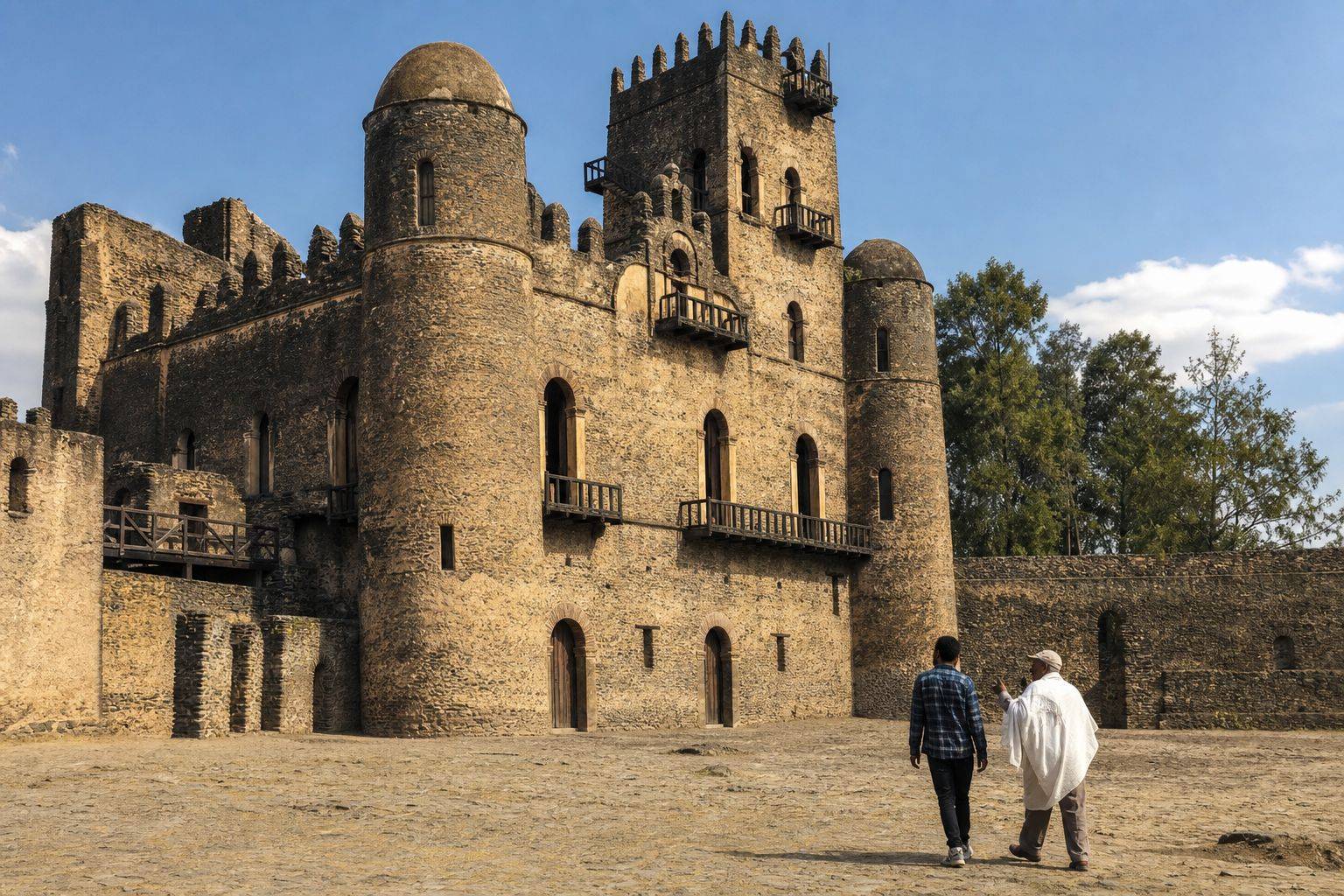
 Fasilides Castle anchors the royal enclosure at Fasil Ghebbi, but the wider Gondar story includes later palaces, churches, baths, and living traditions.
Gondar’s royal enclosure is compact enough to cross on foot, yet it represents generations of court building. One castle rises behind another. Banqueting halls, libraries, residences, walls, and ruined rooms show how a permanent capital grew rather than appearing as one finished design.
Emperor Fasilides established Gondar as a royal capital in 1636. Successive rulers added to the court and surrounding religious landscape. UNESCO recognizes Fasil Ghebbi and several related components in and around the city as a World Heritage property.
The nickname Camelot of Africa appears often in travel writing, but it is not useful. It makes Ethiopian royal architecture sound like a copy of a European legend. Gondar deserves to be understood through its own political, religious, and artistic history.
For a wider comparison of periods and destinations, see Best Historical Places to Visit in Ethiopia.
Current safety note
Gondar is in Amhara Regional State. As of 6 August 2026, both the United Kingdom and the United States currently say do not travel there. The UK’s live advice recommends against all travel to the whole of Amhara because of armed conflict, roadblocks, detention risk, crime, and rapidly changing conditions. The US advisory, dated 1 April 2026, rates Ethiopia overall Level 3, Reconsider Travel, and separately tells the public not to travel to Amhara among other regions, a warning aimed at ordinary visitors, not just government staff.
An operating hotel or an available flight does not override an official warning. If your own government’s current advice says do not travel, postpone the trip. This guide remains useful for historical understanding and future planning, and it is written on that basis, not as a current bookable itinerary.
Why Gondar became important
Before the seventeenth century, Ethiopian rulers often moved with seasonal royal camps. Fasilides established a more permanent base at Gondar. The court attracted builders, clergy, artists, administrators, and traders.
UNESCO describes Fasil Ghebbi as a fortified compound with palaces and public and private buildings shaped by Ethiopian practice and outside influences associated with Indian, Arab, and later Baroque traditions. These influences were adapted rather than simply copied.
The city remained a major centre through the Gondarine period. Painting, manuscript culture, church building, and court life developed around the capital. Political decline did not erase Gondar’s regional importance.
How do I get there
Gondar has its own airport, which the Ethiopian tourism ministry places about 17 kilometres south of the city. Ethiopian Airlines maintains a route page for Addis Ababa to Gondar, but a route existing on the airline’s website is not proof of a current daily flight. Confirm the actual schedule directly with the airline close to your travel date.
By road, the ministry gives a distance of roughly 730 kilometres from Addis Ababa and about 176 kilometres from Bahir Dar. Treat those numbers as geographical context only. Given volatile conditions and the possibility of checkpoints, this guide does not offer a dependable drive time or recommend the road as a safe option while Amhara remains under a do not travel warning.
Until that advice changes, base any transport decision on your own government’s current guidance and direct confirmation from the airline, not on a distance figure or a route page.
Start at Fasil Ghebbi
The royal enclosure is the essential first stop. Its walls surround several major structures built under different rulers.
Fasilides Castle provides the clearest starting point. Round towers, battlements, arched openings, and broad stone walls create the image most visitors associate with Gondar. Walk around the exterior before entering any open interior so you can understand its complete mass.
Other buildings reveal how the court expanded. The palace associated with Iyasu, the chancellery and library linked to Yohannes, Mentewab’s palace, and banqueting structures should be read as a sequence rather than a pile of ruins.
An authorized guide can help identify which walls belong together, what restoration changed, and where a popular story is uncertain. Without that explanation, later structures are easy to confuse. Confirm which interiors and buildings are currently open and safe to enter before you build a route around them.
Fasilides Bath
Fasilides Bath stands outside the main enclosure. A two storey pavilion rises within a rectangular pool and is reached by a stone bridge. The pool is normally empty or partly dry outside ceremonial use, depending on maintenance and season.
The site is closely associated with Gondar’s Timket celebration. During the festival, water, clergy, worshippers, and the historic architecture create a living religious setting.
Do not assume ordinary visitor access remains unchanged during Timket. Festival preparation, crowd control, worship, and security can limit entry, so confirm current opening times, water condition, the festival programme, and photography rules before you go.
Debre Berhan Selassie
Debre Berhan Selassie is a functioning Ethiopian Orthodox church known for its painted interior. The ceiling with repeated winged faces is the most familiar detail, but walls and sanctuary arrangement need equal attention.
Remove shoes before entering. Dress modestly. Men and women may be directed to different areas. Do not cross curtains or enter the sanctuary.
Flash can damage the viewing experience and may threaten delicate surfaces. Use no flash and confirm whether interior photography is allowed. Services, funerals, or private prayer take priority over tourism.
A guide should explain the religious subjects rather than reducing the church to a decorative ceiling. Ask before photographing clergy or worshippers.
Qusquam and other components
The wider UNESCO property includes additional royal, religious, and historic places around Gondar. Qusquam is associated with Empress Mentewab and includes palace and church remains.
Other components can be difficult to reach or interpret without current local guidance. Do not add every named site to a short itinerary simply because it appears on a heritage list. Confirm safe road access, opening status, staffing, ticketing, and whether a registered guide is required for each outer component before including it.
How many days to allow
One full day can cover Fasil Ghebbi, Fasilides Bath, and Debre Berhan Selassie at a reasonable pace when access is safe.
Two days are better for a reader who wants architecture, painting, and a wider historical sequence. Use the second day for Qusquam or another officially open component, then return to the city centre for a slower meal or market walk with local guidance.
During Timket, add days rather than compressing the programme. Roads, crowds, religious schedules, and accommodation demand change the entire visit.
Many travelers combine Gondar with a stop in Axum, the other major historical city in the north, if the route and current advisory allow it.
A one day outline
Begin at Fasil Ghebbi in the morning. Cooler air helps on exposed stone paths, and a guide can establish the historical sequence before the compound becomes busy.
Pause for lunch rather than moving directly to another monument. Visit Debre Berhan Selassie in the afternoon when no service limits access, then continue to Fasilides Bath if current hours allow.
Keep extra time before dark. Transport conditions and checkpoints can change. Avoid road travel after dark outside central urban areas.
This is a planning frame, not a fixed schedule. Confirm all opening hours and local movement advice before you commit to it.
Guides, tickets, and fees
Use an authorized guide at Fasil Ghebbi. Agree on the length, included sites, transport, and fee before beginning.
Entrance charges may be separate for the enclosure, bath, churches, or outer sites. Camera rules can also differ. Confirm every current fee at the official entrance and keep your receipts rather than relying on a price quoted in an old blog post.
A good guide should welcome questions about evidence. They should be able to distinguish a documented building phase from a colourful court legend.
Walking and accessibility
Fasil Ghebbi includes uneven stone, worn steps, open ground, and rooms with limited light. Closed shoes with good grip are more useful than sandals.
Visitors with limited mobility should ask which parts can be reached without stairs. The main exterior views may be easier than upper rooms or rough inner paths.
Sun can be strong at midday, while mornings and evenings may feel cool. Carry water, sun protection, and a warm layer. Rain makes stone slippery.
Altitude may affect some visitors. Rest on the first day and seek medical advice before travel if you have a related condition.
Food, markets, and local context
Gondar is a working regional city, not only a set of monuments. When conditions permit, meals and market visits can add context, but do not wander into unfamiliar areas without current local advice.
Ask a trusted host or guide for an operating restaurant and current food safety information. Orthodox fasting seasons affect menus and make plant based dishes widely available.
Buy contemporary crafts directly from makers or established shops. Avoid objects claimed to be old church or royal items. Protected cultural property may not be legal to sell or export.
Visiting during Timket
Gondar’s Timket celebration is nationally famous, especially around Fasilides Bath. The programme begins with Ketera processions and continues through night prayer, water blessing, and return processions.
The festival is not a performance arranged for visitors. Follow clergy and event stewards, dress modestly, keep away from the covered tabot, and do not enter the water unless explicitly permitted.
Current security warnings matter even during a major celebration. Do not plan festival travel until official advice, local security conditions, flights, accommodation, and insurance all support it.
Read the Timket Festival in Ethiopia guide for ceremony and etiquette.
Photography
Exterior castle photography is usually straightforward from marked paths. Do not climb walls, sit on fragile stone, or move barriers.
Churches require permission and no flash. People require consent for close photographs. Avoid photographing checkpoints, security forces, or sensitive infrastructure.
Drone use needs Ethiopian legal permission and site approval. Do not launch a drone over the royal enclosure, churches, festival crowds, or government areas without written authorization.
The generated hero in this draft is an illustration. Replace it with current authorized photography if possible.
Common mistakes
- Calling Gondar an African copy of a European castle town
- Seeing only Fasilides Castle and ignoring later court buildings
- Visiting Debre Berhan Selassie only for the ceiling photograph
- Entering a church without removing shoes
- Using flash on paintings
- Assuming every UNESCO component is open
- Building a festival trip around old schedules
- Publishing old fees and transport times
- Driving after dark without current local advice
- Treating an available flight as proof of safety
A responsible future visit
When official conditions allow travel again, give Gondar enough time for one complete historical sequence. Begin with the royal enclosure, connect it to Fasilides Bath, then enter the painted church as a place of worship rather than an art display.
Use a guide who explains the Ethiopian court on its own terms. Leave uncertain stories labelled as such. Most of all, put current safety above a fixed itinerary. The monuments have survived centuries. A responsible visitor can wait until the journey is genuinely supportable.