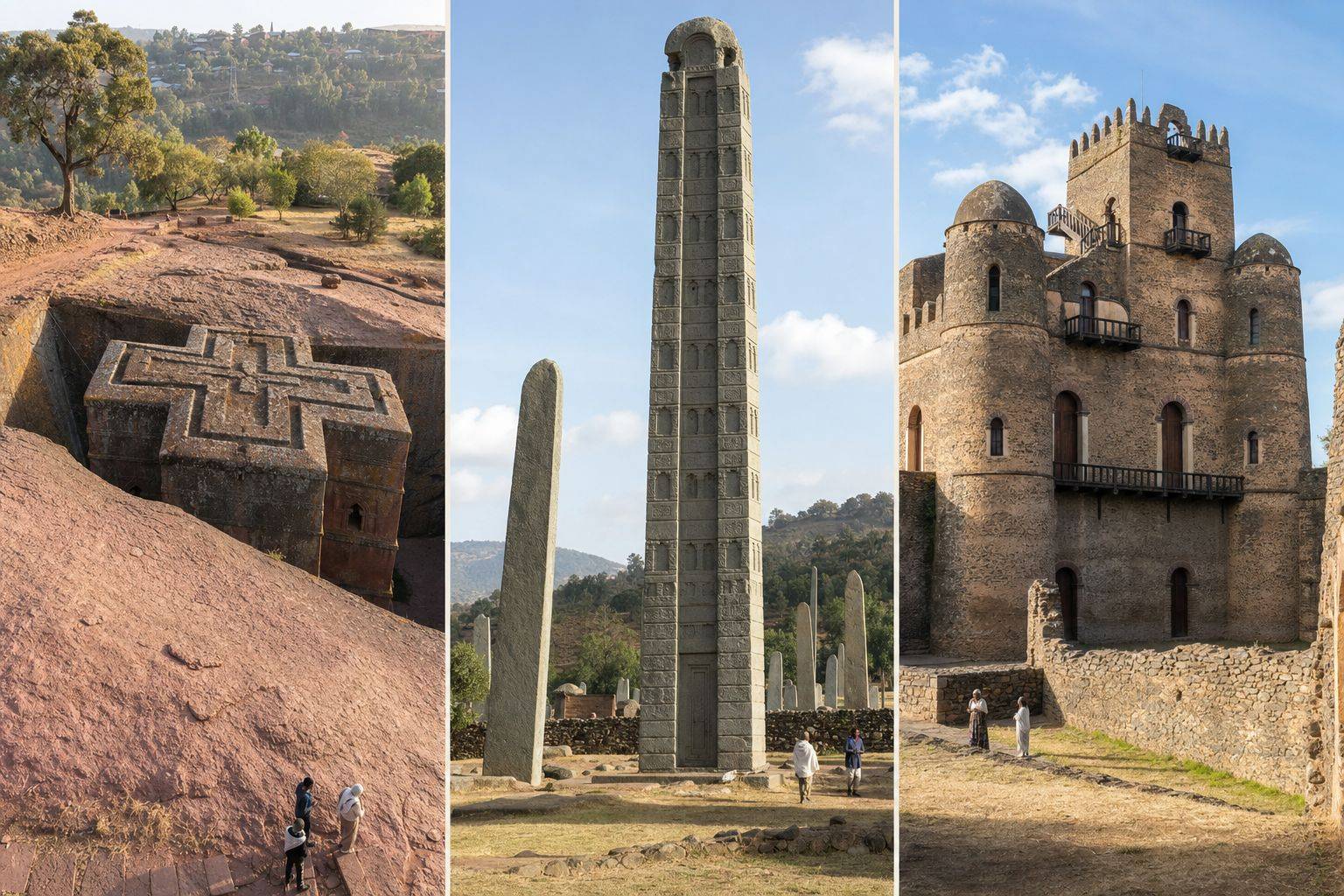
 Lalibela, Aksum, and Gondar reveal different periods of Ethiopian history. They should not be compressed into one story or rushed through in one day.
Ethiopia’s historical places are not arranged along one easy route. The rock churches of Lalibela sit in the northern highlands. Aksum’s stelae stand much farther north. Gondar preserves the remains of a royal capital, while Harar’s walled city belongs to a different geography and religious history in the east. Tiya and Konso ask visitors to look beyond monumental palaces and churches toward archaeology, settlement, and living landscapes.
That distance is useful. It prevents a serious mistake: treating Ethiopian history as one old Christian kingdom with a few dramatic buildings. The country holds ancient trade networks, Islamic scholarship, royal capitals, rock architecture, burial monuments, agricultural engineering, and living sacred places.
This guide does not rank the sites from most to least important. It helps you decide what belongs in your trip and what deserves a separate journey.
Read the safety note before planning
The six sites in this guide do not share one safety status. Each has its own current situation, and this section separates them rather than giving one blanket warning.
As of 6 August 2026, both the United Kingdom and the United States currently say do not travel to Amhara Regional State, which includes Lalibela and Gondar, and to Tigray, where Aksum is located. The UK’s live advice recommends against all travel to those regions, and civilian flights to and from Tigray have been suspended since 29 January 2026. The US advisory, dated 1 April 2026, rates Ethiopia overall Level 3, Reconsider Travel, and separately tells the public, not only government employees, not to travel to Tigray, Amhara, Afar, Central Ethiopia, South Ethiopia, and several other regions.
That last point matters for two sites that do not get the same detailed guides elsewhere in this series. Tiya sits in Central Ethiopia, which the current US advisory places at the stronger Level 4, Do Not Travel, while Australia’s Smartraveller advice calls for a high degree of caution there. Konso sits in South Ethiopia, which the current US advisory also says not to travel to.
Harar is a real exception worth naming clearly. It is not covered by the UK’s blanket Amhara or Tigray warnings. The US Level 3, Reconsider Travel rating still applies nationally, and Australia advises a high degree of caution specifically in Harar, but Harar’s current status is meaningfully different, and better, than Axum’s, Gondar’s, or Lalibela’s. That difference does not remove the need to check current advice before travelling there.
Check these conditions again yourself close to any planned trip. Flight operations, government restrictions, insurance validity, and local access all change, and this guide can go out of date faster than a live advisory does. This article can help with future planning and historical understanding. It is not a recommendation to ignore an official warning. A scheduled flight, open hotel, or available tour does not by itself establish that a trip is safe.
How to choose between the sites
Think about the kind of history you want to encounter.
Choose Lalibela for sacred rock architecture and a living pilgrimage setting. Choose Aksum for archaeology tied to an ancient kingdom and long distance trade. Choose Gondar for royal architecture and a concentrated group of castles, churches, and court sites. Choose Harar for a walkable walled Muslim city where homes, lanes, markets, and worship remain connected. Choose Tiya for a focused archaeological visit to carved stelae. Choose Konso for a cultural landscape shaped by terraces, fortified settlements, and community knowledge.
Time matters too. Lalibela, Aksum, and Harar deserve at least two nights each when travel is possible. Gondar can reveal its main monuments in one full day, though a second day gives churches and nearby sites more space. Tiya can fit into a day journey from Addis Ababa if current roads and access allow. Konso requires a longer southern route and local guidance.
Lalibela
Lalibela’s eleven medieval churches were carved from living rock rather than assembled from separate blocks. UNESCO describes two main groups divided by a watercourse named Jordan, with Biete Ghiorgis standing apart and connected by trenches and passages.
The site’s power comes from more than engineering. These are active churches with priests, worshippers, services, processions, and pilgrims. Doorways worn by centuries of movement and dark interiors lit by small openings make the place feel very different from an archaeological ruin.
Biete Medhani Alem is known for its scale and exterior columns. Biete Mariam often feels more intimate, with interior details that reward a careful look. Biete Ghiorgis is the most immediately recognizable because of its cross shaped plan and deep trench.
Do not reduce the visit to the famous overhead view. Walk slowly through the connected passages with an authorized guide who can explain which spaces are churches, tombs, symbolic places, or practical routes. Remove shoes where instructed. Dress modestly. Ask before photographing clergy or worship.
Best for: Sacred architecture, walking through a connected religious landscape, and travellers prepared to follow church etiquette.
Before you plan around Lalibela, check current security, flights, road access, church opening arrangements, entrance fees, guide rules, and photography restrictions, since any of these can shift with little notice.
Read the full Lalibela Travel Guide for First Time Visitors before building an itinerary.
Aksum
Aksum was the centre of a powerful kingdom that connected the African interior with routes toward the Red Sea, Arabia, and the Mediterranean world. UNESCO dates the main civilization from roughly the first to the eighth centuries, while the wider site includes remains from a longer period.
The northern stelae field provides the clearest visual introduction. Tall monoliths imitate architectural features such as doors and storeys. Nearby tombs and archaeological remains connect the monuments to elite burial practices rather than treating them as isolated towers.
The city is also central to Ethiopian Orthodox tradition. The Saint Mary of Zion church complex is associated with long standing beliefs about the Ark of the Covenant. Visitors should distinguish between documented archaeology and matters of faith. Do not present a sacred belief as something a tourist can demand to inspect.
Aksum works best when the stelae field, tombs, archaeological museum, church area, and selected nearby sites are understood together. Yeha may be included in a longer regional plan when access and security allow, but it should not be squeezed into a hurried afternoon without checking road conditions.
Best for: Ancient state history, archaeology, inscriptions, trade connections, and the meeting point between material evidence and living belief.
Before you plan around Aksum, check current Tigray access, civilian flight status, road safety, site opening, museum access, entrance fees, and guide availability, since conditions in the region can change quickly.
Read the full Axum Travel Guide and Historical Importance for a deeper route.
Gondar
Gondar became a permanent royal capital under Emperor Fasilides in the seventeenth century. At Fasil Ghebbi, visitors can walk among castles, halls, libraries, and other court buildings inside a fortified compound.
The architecture resists a simple label. UNESCO notes Ethiopian forms together with influences associated with Indian, Arab, and later Baroque traditions. Calling it an African version of a European castle misses the point. The complex developed within an Ethiopian royal and religious setting.
The main castle gives the strongest first impression, but the compound becomes clearer when a guide identifies later buildings and explains how successive rulers changed the court. Beyond the enclosure, Fasilides Bath is important for both architecture and its continued association with Timket. Debre Berhan Selassie is known for its painted interior and remains a functioning church.
One full day can cover the central sites without rushing. A second day allows Qusquam or other components of the wider UNESCO property if they are open and safely accessible.
Best for: Royal history, concentrated architecture, church painting, and travellers who prefer a compact urban base.
Before you plan around Gondar, check current Amhara security, flights, roads, entrance fees, church access, and whether the various component sites are open.
Read the full Gondar Travel Guide for Castles, Culture, and Tips.
Harar Jugol
Harar Jugol is a fortified historic city in eastern Ethiopia. Its importance lies in the complete urban fabric: walls, gates, mosques, shrines, homes, lanes, markets, and community institutions.
UNESCO records 82 mosques and 102 shrines within the heritage description, while emphasizing the exceptional design of traditional Harari houses. Those houses organize social space through built seating, wall niches, colour, and decorative objects. A visit that sees only gates and market lanes misses much of the domestic architecture.
Harar is a living Muslim city, not an open museum. Dress modestly, ask before entering a mosque or home, and follow local guidance on photography. Friday prayer and religious occasions affect movement and access. The narrow lanes are best explored with a knowledgeable local guide who can explain neighbourhood boundaries and introduce home interiors only with permission.
The popular evening hyena feeding display needs ethical judgment. Ask how the activity is managed, keep a safe distance, and do not treat wild animals as props. A historical guide does not need that experience to make Harar worthwhile.
Best for: Islamic history, urban form, living neighbourhoods, markets, and architecture at a human scale.
Harar’s current status is meaningfully different from Lalibela’s, Gondar’s, and Aksum’s. It does not fall under the same blanket do not travel warning that the UK applies to Amhara and Tigray. The US Level 3, Reconsider Travel rating still applies nationally, and Australia’s Smartraveller advice calls for a high degree of caution specifically in Harar, so this is not a reason to skip checking current advice, only a reason not to treat Harar the same as the northern sites.
Before you plan around Harar, check current road and flight options, local security, house visit permission, mosque access, guide registration, and any current wildlife guidance for the hyena feeding.
Tiya
Tiya offers a quieter archaeological experience south of Addis Ababa. UNESCO records 36 monuments at the site, including 32 carved stelae. Many display sword forms and other symbols whose meanings remain difficult to interpret.
That uncertainty is part of responsible interpretation. Do not repeat a confident story about every symbol unless a qualified archaeological source supports it. The site represents a past culture that researchers still work to understand.
Tiya is smaller than Lalibela or Fasil Ghebbi. A good visit depends on unhurried observation, clear interpretation, and realistic expectations. It is suited to travellers interested in archaeology rather than those seeking a large monument complex.
Combine it only with places that fit the route and available daylight. Never assume an old day tour itinerary reflects current road conditions.
Best for: Carved monuments, archaeology, and a manageable historical excursion from Addis Ababa when roads are safe.
Tiya sits in Central Ethiopia, which the current US advisory places at Level 4, Do Not Travel. Australia’s Smartraveller advice also calls for a high degree of caution in the region. That status is easy to overlook because Tiya is often framed as a simple day trip from the capital, so check current advice specifically for Central Ethiopia rather than assuming a short distance from Addis Ababa means a lower risk.
Before you plan around Tiya, check current site access, road conditions, the official interpretation on display, the entrance fee, and guide availability.
Konso Cultural Landscape
Konso is not one monument. It is a broad cultural landscape of dry stone terraces, fortified settlements, community spaces, generation stones, and living agricultural knowledge.
UNESCO describes a tradition extending across many generations. The terraces manage soil and water in a difficult environment. Walled settlements occupy strategic high ground, while shared spaces inside the towns continue to have social roles.
Visitors need local permission and guidance because these are inhabited communities. A viewpoint photograph cannot replace a conversation about how terraces are maintained, how public spaces function, and which places are restricted.
Descriptions of grave markers, generation stones, and ritual forests require care. Do not touch objects, enter sacred areas, or reproduce sensitive stories without permission. Avoid language that presents residents as unchanged survivors from the past. Konso is a contemporary community maintaining and adapting inherited systems.
Best for: Living landscape, community engineering, settlement history, and travellers willing to listen rather than collect sights.
Konso sits in South Ethiopia, which the current US advisory also says not to travel to. The Ministry of Tourism states that visitors must report to the Tourist Information Centre, pay a fee, and arrange a mandatory guide before entering the community areas, but the current fee amount and village level rules are not published anywhere this guide could confirm, so treat those as needing a local check rather than a fixed cost.
Before you plan around Konso, check the current route, community entry arrangements, local guide requirements, photography permission, accommodation, and regional safety.
Other sites worth a separate plan
Ethiopia’s World Heritage list extends beyond these six choices. Melka Kunture and Balchit preserve archaeological and palaeontological evidence in the highlands and joined the World Heritage List in 2024. The Lower Valley of the Awash and Lower Valley of the Omo hold evidence central to human origins research. The Gedeo Cultural Landscape and Bale Mountains National Park add further cultural and natural depth.
Lake Tana’s island monasteries are important to Ethiopian Christian history, though the proposed World Heritage property remains on Ethiopia’s tentative list rather than the inscribed list. Access, religious restrictions, and current Amhara security all need careful checking.
Yeha is essential to discussions of early northern history, but present travel conditions in Tigray make access a live safety question. Adadi Maryam can introduce rock church architecture closer to Addis Ababa when local road and site conditions permit.
Do not build an itinerary by counting UNESCO labels. Choose places that form a coherent historical question and can be reached responsibly.
Natural landscapes that pair with history
Simien National Park and the Danakil Depression are not historical monuments, but both often appear in northern itineraries.
The Simien Mountains reveal how highland geography, settlement, conservation, and travel routes relate to the historic cities. The park is also a World Heritage natural property. It requires a separate trekking plan, altitude preparation, permits, and current safety review.
The Danakil Depression presents salt landscapes, active volcanic terrain, and Afar communities whose knowledge is essential to any visit. It is not a casual extension from a cultural circuit. Extreme heat, remote access, volcanic hazards, basic facilities, and security requirements demand a recognized operator and a dedicated plan.
Read the Simien Mountains Travel Guide and the Danakil Depression Travel Guide and Safety Tips before considering either.
Build a route by region
When conditions permit, travellers often imagine a northern circuit linking Lalibela, Gondar, Aksum, and Simien. The map makes that look efficient. In reality, road distance, mountain terrain, flight schedules, seasonal weather, and security can separate the sites sharply.
Do not book a tight chain of nonrefundable connections. Leave buffer days and verify each leg independently. If one region is under an official warning, remove that leg rather than searching for an unofficial workaround.
An eastern route centred on Harar is a distinct journey. It can connect with Dire Dawa and nearby cultural sites when access is safe. It should not be treated as a quick detour from a northern itinerary.
A southern heritage route can connect Tiya, selected archaeological areas, Konso, and other cultural landscapes, but travel time is substantial. Community based guidance matters more than checking off names.
How many days to allow
A meaningful heritage trip needs pauses.
- Lalibela: At least two nights, with more time during major feasts
- Aksum: At least two nights when travel reopens
- Gondar: One full day, preferably two
- Harar: Two or three nights
- Tiya: One careful day journey when conditions allow
- Konso: At least two nights within a wider southern route
These are planning frames, not current access promises. Recheck transport time, road safety, opening hours, and minimum guide requirements closer to your travel date.
Guides, fees, and permissions
Use authorized local guides where available. A good guide does more than recite dates. They help visitors understand sacred boundaries, identify later restoration, ask permission for home visits, and avoid restricted areas.
Entrance fees, guide systems, camera charges, and opening hours can change. Pay at official points and request a receipt where the system provides one. Avoid publishing exact prices until they have been checked close to publication.
Some churches have separate access rules for men and women or restrict entry to particular sacred spaces. Some communities limit photography. A paid ticket does not cancel those rules.
Responsible heritage behaviour
Historic places are vulnerable to small actions repeated by many visitors.
- Do not climb walls, stelae, roofs, or carved rock.
- Do not touch paintings, manuscripts, or old wood.
- Remove shoes where instructed and keep socks clean.
- Ask before photographing people, worship, homes, or sacred objects.
- Do not use flash on paintings or manuscripts.
- Keep food and drink away from protected interiors.
- Hire locally and buy directly from identified makers where practical.
- Carry out waste.
- Report damage to site staff rather than moving an object yourself.
Common planning mistakes
The first mistake is trying to see too much. A rushed visit turns different historical periods into a blur.
The second is treating a UNESCO inscription as a guarantee of visitor infrastructure. Protection status does not promise open roads, clear signs, reliable toilets, or simple booking.
The third is separating monuments from living communities. Churches still hold services. Harari homes remain homes. Konso settlements remain inhabited. Respect does not end when you buy a ticket.
The fourth is using old safety information. Northern conditions can change within days. Current official advice must overrule an attractive itinerary.
The fifth is presenting oral tradition and archaeology as the same kind of evidence. Both matter, but they answer different questions. Name a belief as belief and an archaeological interpretation as interpretation.
A stronger first trip
Choose two or three places that reveal different histories rather than six places that merely look old. For example, Harar and Tiya create a manageable contrast between living urban heritage and archaeological monuments when transport and safety allow. A future northern route could pair Lalibela’s sacred architecture with Gondar’s royal compound, then add Aksum only if access is stable and enough time remains.
Before paying, verify every region, transport leg, site rule, and insurance condition. Then slow down once you arrive. Sit with a carved surface, listen to a guide explain a contested interpretation, and notice where worship or daily life continues around the monument.
Ethiopia’s historical places reward that patience. They do not tell one simple national story. Together they show states rising and declining, sacred traditions continuing, cities exchanging ideas, and communities shaping difficult landscapes across centuries.