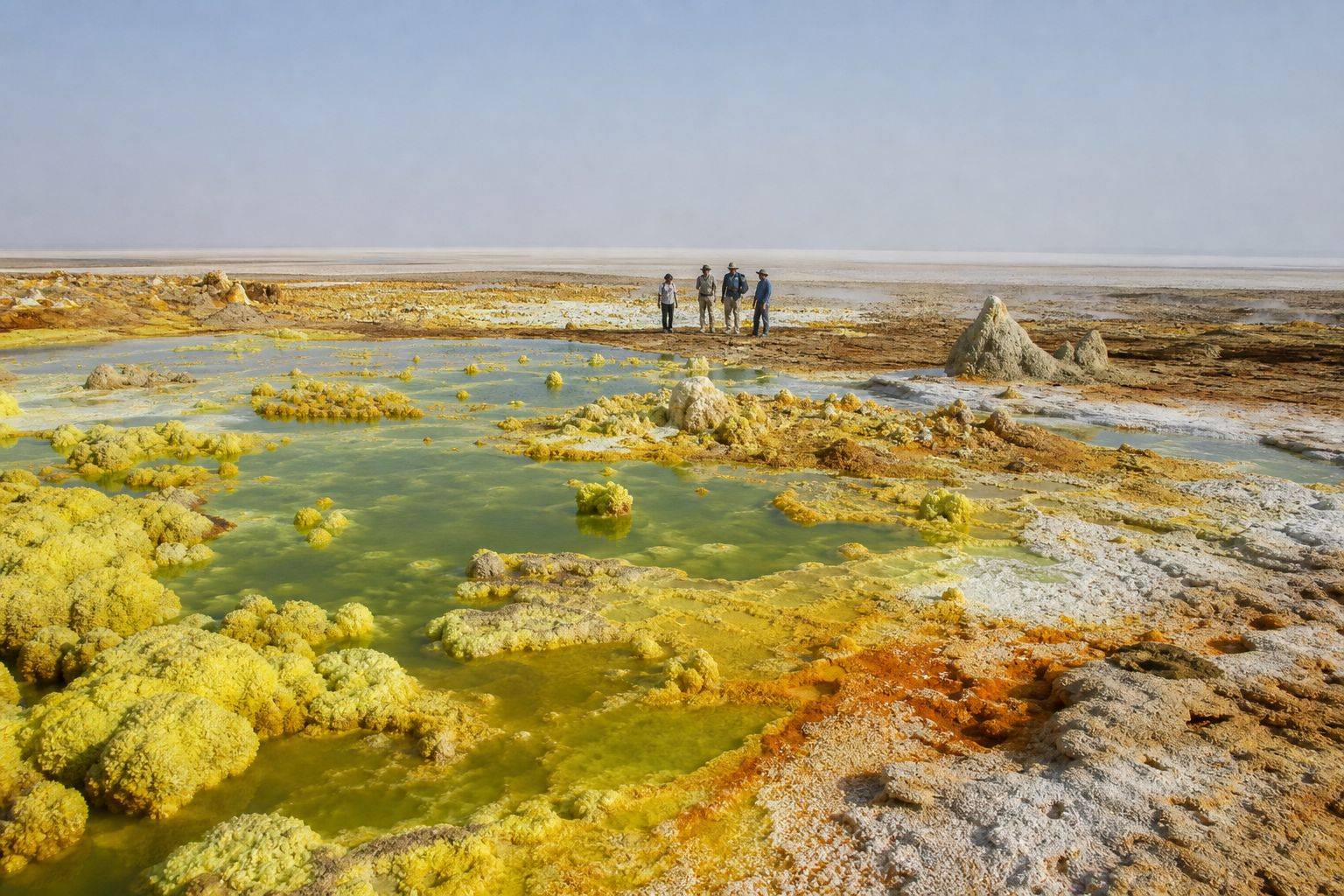
 Dallol’s mineral crusts and acidic pools are fragile and hazardous. Visitors must stay on the route chosen by trained local guides.
Danakil is often sold through a string of dramatic labels. Those labels can hide the practical truth: this is a remote lowland region with extreme heat, active geology, difficult roads, limited water, basic sleeping conditions, and little medical support.
It is also not one attraction. The bright hydrothermal terrain at Dallol, broad salt flats, Afar settlements, camel caravans, and the volcanic landscape around Erta Ale are separate places with different hazards. A photograph of one does not describe the whole journey.
Travellers comparing northern itineraries should also separate this lowland expedition from the Simien Mountains trek and the heritage routes in Best Historical Places to Visit in Ethiopia.
No independent traveller should improvise this route. A credible trip requires official access, a recognized operator, experienced Afar guides, suitable vehicles, enough water and fuel, security arrangements, medical planning, and a willingness to cancel.
Current access and security note
Read this before anything else. As of 6 August 2026, the Danakil Depression is not a normally accessible destination for foreign visitors, and this guide should not be read as describing a trip you can simply book.
The United States currently says do not travel anywhere in Afar, the region that contains Dallol, the salt flats, and Erta Ale. This is part of its 1 April 2026 advisory, which rates Ethiopia overall Level 3, Reconsider Travel, while singling out Afar and several other regions for the stronger Level 4, Do Not Travel. The United Kingdom’s current advice says foreign nationals cannot use airports in Afar at all, because of Ethiopian authority restrictions. That rules out presenting Semera as a normal fly in gateway for an international visitor, and this guide does not present it that way. The UK also advises against all travel within ten kilometres of the Eritrean border and notes irregular armed clashes in parts of Afar.
Anyone who nevertheless travels to the Danakil despite this advice should, according to the UK, use a recognized tour company and verify that the group has an armed police or military escort. A Ministry hosted tour listing separately describes an armed escort as mandatory for visits to the area. That description comes from a tour listing, not a published law or regulation, so this guide does not treat booking a tour with an escort as a simple green light or proof of legality. The current legal source of any escort requirement, along with permits, fees, checkpoints, and land route conditions, is not confirmed here.
Confirm airport restrictions, land routes, border limits, security escort rules, permits, and your own government’s advice immediately before you consider booking, since conditions in this region can change quickly and with little warning. Do not use a tour company’s willingness to accept payment as proof that travel is safe, legal, or currently permitted. If official advice, local authorities, or insurance rules do not support the trip, do not go.
Dallol is not Erta Ale
Dallol is a hydrothermal area known for bright mineral deposits, salt formations, acidic pools, gas, and crusts that can be thin or unstable. Visitors normally approach by vehicle and continue on foot with local guidance.
Erta Ale is an active shield volcano in a different part of the region. Conditions at its crater change. Lava visibility is not guaranteed, and old photographs do not prove what will be visible during a future visit.
The salt flats form another distinct landscape. Work and transport around salt are part of Afar economic life, not a staged scene. Visitors should not obstruct workers or animals for photographs.
An itinerary that promises every feature in very little time may be hiding long driving hours, poor rest, and unsafe heat exposure.
What Dallol requires
At Dallol, the ground deserves more attention than the view. Bright crust may cover hot, acidic, or unstable material. Gas can irritate eyes and lungs. Heat reflects from pale salt and open terrain.
Stay directly behind the local guide. Do not choose your own route for a cleaner photograph. Never touch, taste, or step into a pool. Do not collect salt or mineral formations from protected or active areas.
Strong shoes should cover the feet. Loose sandals offer little protection from sharp salt and hot ground. Wear sun protection and carry water that remains accessible.
Anyone with a respiratory, heart, heat related, or mobility concern should seek medical advice before considering the visit. The terrain is not suitable for every traveller.
What Erta Ale requires
Erta Ale adds volcanic hazards, rough access, darkness, and often a strenuous walk. The route and viewing point can change because the volcano changes.
Erta Ale is an active volcanic area, and the Smithsonian Global Volcanism Program tracks its activity for scientific context. The most recent report located for this guide covered 26 November to 2 December 2025, well before the current publication date. That report is not proof of what will be visible on any future visitor’s chosen date, whether that means a lava lake, visible eruption, or a quiet crater. Check the Smithsonian’s program directly for the latest report before travel, and treat whatever it says as a snapshot, not a promise. Access decisions themselves belong to Ethiopian authorities and trained local teams.
Do not approach a crater edge outside the guide’s limit. Volcanic ground can be unstable, gas can shift with wind, and darkness can hide cracks. A bright glow does not make the area safe. Confirm the current approach, walking time, camp location, gas conditions, crater exclusion zone, recent activity, and whether access is officially open before you commit to the trip.
Lava should never be guaranteed in marketing. Ask an operator what happens if the volcano is obscured, inactive at the visible vent, or closed.
Heat is a medical risk
Heat in the Danakil is not ordinary sightseeing discomfort. The body may struggle to cool itself, particularly during long exposed walks.
Warning signs can include headache, nausea, cramps, heavy weakness, dizziness, and unusual behaviour. Confusion, collapse, or loss of coordination can signal a medical emergency.
Prevention requires more than carrying one bottle:
- Drink regularly according to medical guidance and conditions.
- Replace salts through suitable food or electrolyte planning.
- Cover skin with light breathable clothing.
- Use a hat, sunglasses, and sunscreen.
- Schedule exposed walking during the coolest practical period.
- Rest in shade whenever available.
- Tell the guide about symptoms immediately.
Do not hide illness to avoid delaying the group. A reliable operator will stop, cool, assess, and evacuate rather than protect the schedule.
Questions to ask an operator
Ask detailed questions before sending money.
- Is the company currently licensed to operate this route?
- Which permits and local approvals are included?
- Which Afar guides join the trip?
- What official security support is required and provided?
- How many vehicles travel together?
- Is there a spare vehicle or recovery plan?
- How much drinking water is carried per person, plus emergency reserve?
- How are water and food stored in the heat?
- Who has first aid training?
- What communication works when phone service fails?
- Where is the nearest usable medical facility?
- What triggers cancellation?
- What refund or credit applies after an official closure?
Get answers in writing. A vague promise that the guide knows everything is not an emergency plan.
How do I get there
There currently is no normal way for a foreign visitor to fly into the Danakil region. The UK Foreign Office states that foreign nationals cannot use airports in Afar, which rules out treating Semera or any other Afar airport as an ordinary gateway. Do not book a flight into the region on the assumption that this restriction has quietly lifted. Confirm directly with the airline and with current government advice.
Overland access typically runs through organized tour convoys rather than independent travel, and even that access depends on permits, checkpoints, and security conditions that are not confirmed here. This is not a route to plan around a fixed arrival date. If official advice, airport restrictions, or your operator cannot give you a clear, current answer on how the group will actually reach the region, treat that as a reason to postpone rather than improvise.
Vehicles, fuel, and communication
Remote travel should use suitable maintained vehicles with experienced drivers. A group should not depend on one vehicle without recovery capacity.
Ask about spare tyres, tools, fuel reserve, shade, water reserve, and radio or satellite communication. Phone coverage may fail. A power bank does not solve the absence of a network.
Leave the complete itinerary, vehicle details, operator contact, and expected return time with a reliable person outside the group.
Avoid driving after dark except where a controlled operator plan makes it necessary and authorities permit it. Darkness increases collision, navigation, and recovery risks.
Sleeping and sanitation
Accommodation can be very basic. Some itineraries use simple camps, mats, or open sleeping areas. Toilets and running water may be absent.
Ask exactly what is provided. Words such as camp and lodge can describe very different conditions.
Bring a clean sleeping liner if suitable, personal hygiene supplies, hand sanitizer, toilet paper, a headlamp, and sealed bags for waste. Carry out nonorganic rubbish.
Food must be stored safely in high heat. Ask how meat, dairy, and cooked dishes are kept. People with allergies should carry appropriate backup food and medicine.
Packing list
- Closed shoes with solid grip
- Light long sleeves and breathable trousers
- Wide sun hat
- Sunglasses
- High protection sunscreen
- Personal water bottles or hydration system
- Electrolyte plan suited to your health
- Headlamp and spare batteries
- Warm layer for a windy night if current forecast requires it
- Dust protection that does not restrict breathing
- Personal medicine
- Compact medical kit
- Hand sanitizer and hygiene supplies
- Power bank
- Secure copies of identification, permits, and insurance
- Dry bags or sealed bags for electronics
Ask the operator what sleeping equipment, food, water, and safety equipment are included, then inspect them yourself before departure rather than taking the listing at its word.
Insurance and evacuation
Standard travel insurance may exclude regions under an official warning, volcanic areas, remote trekking, security incidents, or evacuation from places without road access.
Give the insurer the real route and planned activities. Ask for written confirmation that medical treatment and evacuation are covered despite the destination and current advisory.
If cover is invalid, do not travel. Paying privately for a complex evacuation may be impossible, even if you have money available.
The operator should know the nearest realistic medical options, not simply name a distant hospital. Ask how long evacuation could take under actual road conditions.
Respect for Afar communities
The Danakil is home, work area, and cultural landscape for Afar communities. Local expertise is not decorative. It is essential to route finding, access, water, security, and understanding the land.
Ask before photographing people, homes, salt workers, animals, or vehicles. Do not block a caravan or direct workers into poses. Agree on portrait permission clearly.
Pay local guides and services through transparent arrangements. Avoid handing items or money randomly to children. Ask a trusted community contact what form of support is appropriate.
Do not describe people as surviving in an empty hostile land. The region has long standing systems of movement, work, social authority, and environmental knowledge.
Environmental responsibility
Hydrothermal formations are fragile. One footprint can break a crust that took time to form. Stay on the route even if earlier visitors have left marks elsewhere.
Do not collect minerals, salt crystals, volcanic rock, or cultural objects. Do not leave plastic bottles, food packaging, wipes, or batteries.
Use established toilet arrangements and keep waste away from water and settlement areas. Operators should carry rubbish out rather than burn plastic at camp.
Vehicle groups should follow approved tracks. Driving across unmarked salt or crust can damage surfaces and create recovery problems.
Photography without taking risks
Use a zoom rather than stepping toward a pool or crater edge. Keep both feet stable before raising the camera. Do not walk backward while filming.
Bright salt and mineral surfaces can fool exposure, so adjust the camera from a safe position rather than moving around constantly.
Drone use requires Ethiopian legal permission, security approval, community consent, and operator agreement. Border proximity and sensitive areas make casual drone use especially risky.
The generated hero in this draft is an illustration, not evidence of current conditions. Replace it with authorized real photography before publication if possible.
Common warning signs in a tour offer
- Guaranteed lava visibility
- No clear permit or security explanation
- One vehicle for a remote group
- No written water plan
- No first aid or communication detail
- Driving and walking times that leave almost no rest
- Pressure to pay immediately because access may close
- Refusal to identify local guides
- No cancellation rule for official restrictions
- Claims that government travel warnings never matter
Who should postpone even when tours operate
Postpone if you cannot obtain valid insurance, if official advice conflicts with travel, or if airport and land restrictions make the route uncertain.
Medical conditions affected by extreme heat, exertion, dust, gas, or delayed treatment require professional advice. A traveller who cannot walk on uneven ground, sleep in basic conditions, or follow a group decision may need a different destination.
There is no shame in deciding that the Danakil is not appropriate. Good travel judgment includes refusing an experience whose risks cannot be controlled.
The decision comes before the itinerary
Start with permission, safety advice, insurance, operator standards, and health. Only then compare Dallol, salt flats, and Erta Ale.
A responsible operator should make cancellation possible, explain uncertainty honestly, and welcome detailed questions. A responsible traveller should follow Afar guidance, protect fragile ground, and accept that heat or volcanic conditions can end a day early.
The Danakil does not need exaggeration. Its geology, scale, and human knowledge are already extraordinary. The right visit, if conditions support one, is the visit that returns every person safely and leaves the landscape intact.