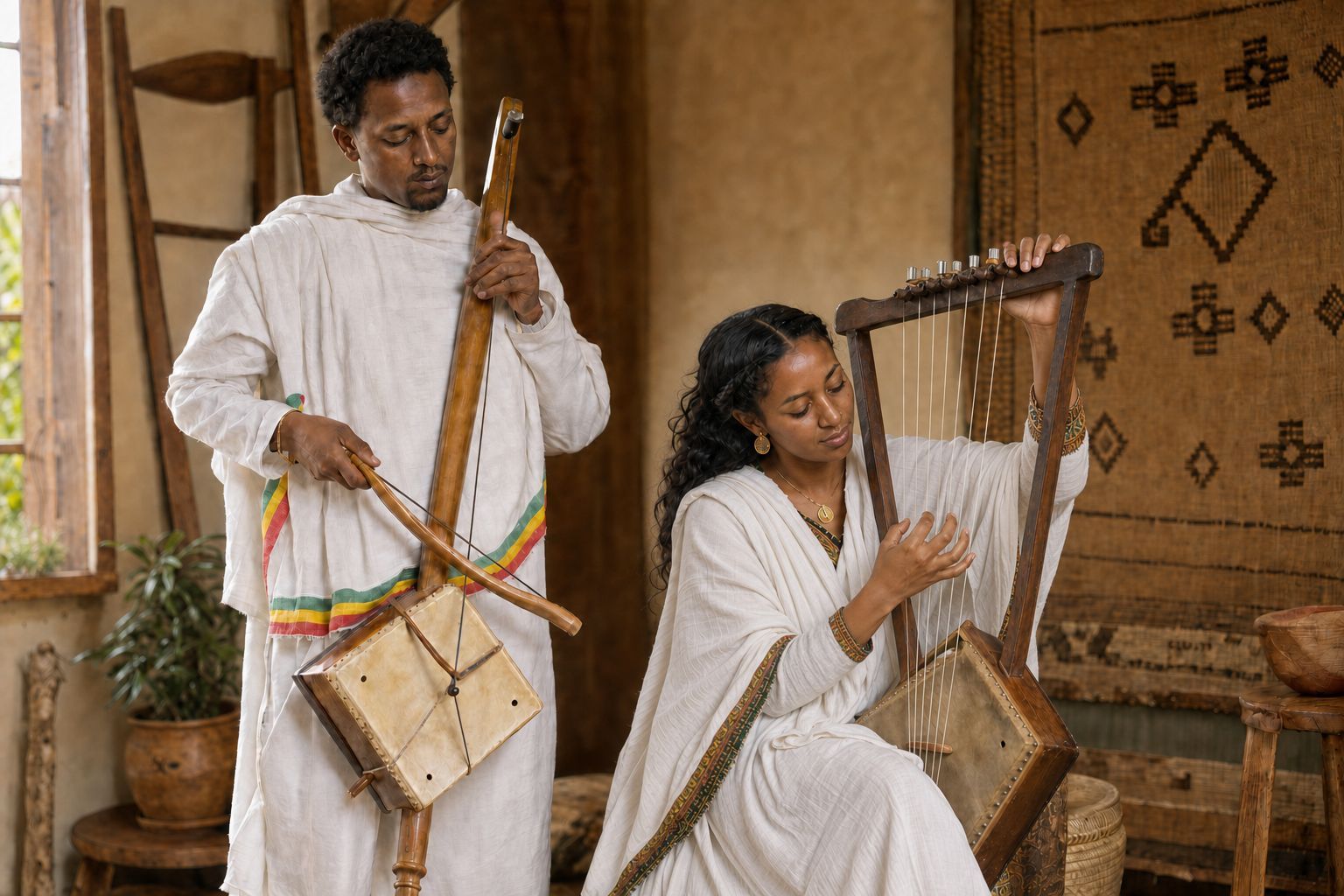
Original AI generated hero image showing traditional string performance beside a modern jazz instrument.
The first Ethiopian song you hear may be a slow Amharic ballad, a bright Oromo dance track, a Tigrinya wedding song, a church chant, or a jazz recording built around an Ethiopian melodic mode. None of those sounds can stand for the whole country. Ethiopia has many languages, regions, faith traditions, and local performance practices, so its music is better approached as a large family than as a single genre.
That is good news for a beginner. You do not need to master every label before enjoying the music. Start by learning what to listen for: the shape of the melody, the language, the rhythm, the instruments, the setting, and the story carried by the singer.
Genre, mode, and performance tradition are different
Several labels commonly presented as Ethiopian genres actually describe different things. Tizita can refer to a musical mode, a song form, and an emotional theme. Azmari describes a type of performer and performance setting. Zema is a sacred vocal tradition. Ethio jazz is a modern fusion. Regional labels may identify a language community more than one fixed musical structure.
Keep that distinction in mind when building a playlist. It prevents a common mistake: forcing living traditions into rigid boxes that musicians themselves may not use in the same way.
Tizita and the sound of memory
Tizita is one of the most useful entry points into Ethiopian music. The word is associated with memory, longing, and nostalgia. Songs in this family often move slowly and leave room for the singer to stretch a phrase. The feeling can be intimate even when the arrangement includes a full band.
There is no single definitive tizita recording. Singers and instrumentalists interpret the form differently, and newer musicians continue to reshape it. Listen to several versions. Notice how one singer leans into sadness while another makes the same musical idea feel warm or reflective.
Smithsonian Folkways describes tizita as a beloved Ethiopian song form connected with longing and nostalgia. That is a useful guide, but the best lesson comes from comparing performances rather than memorizing a definition.
Bati, Ambassel, and Anchihoye
Bati, Ambassel, Tizita, and Anchihoye are often named as important Ethiopian qenet, or melodic mode families. A mode is not simply a Western major or minor scale with a different name. It gives musicians a melodic framework and a recognizable emotional color, but the exact treatment changes with the song, performer, and local practice.
Bati is often heard in both brighter and more reflective forms. Ambassel is strongly associated with northern highland musical practice and appears in vocal and instrumental music. Anchihoye is often described as having a distinctive tension that experienced listeners recognize quickly.
These short descriptions are only starting points. Transliteration and musical analysis vary between sources, so treat any detailed scale diagram as something to check with a local musician or ethnomusicologist rather than a fixed reference.
Azmari performance
An azmari is a singer, poet, and musical commentator, traditionally associated with instruments such as the masenqo. In an azmari bet, the performance can be social and responsive. A singer may improvise lines about people in the room, praise a guest, tease someone, or comment on public life. The words matter as much as the melody.
Visitors who do not understand the language may hear only the rhythm and laughter. An Amharic speaking companion can explain the tone, but even a translation may miss wordplay and double meanings. Treat the room as a live social exchange, not a museum display. Ask before recording performers or guests.
Zema and sacred sound
Zema is the liturgical music of the Ethiopian Orthodox Tewahedo Church. It belongs to worship, religious learning, and a long oral tradition. Church performance may include voices, prayer staffs, sistrums, and drums, depending on the service and occasion.
This is not background entertainment. If you encounter zema during a service or festival, observe respectfully, follow local guidance, and avoid blocking worshippers for a photograph. UNESCO identifies zema as a distinctive Ethiopian liturgical form and has supported documentation of the country’s living music and dance traditions.
Regional traditions deserve their own listening
Oromo music includes many local forms, languages, rhythms, and social settings across a very large region. Some songs center on love or daily life. Others carry history, political memory, praise, or community identity. It is more accurate to ask which Oromo artist, place, language variety, and context you are hearing than to expect one Oromo sound.
Tigrinya music likewise includes wedding music, dance songs, modern popular recordings, and older instrumental and vocal traditions. Rhythmic movement and close links between music and dance are common, but no short formula covers every performance in Tigray or Eritrean Tigrinya communities.
Gurage musical traditions are often recognized for energetic rhythm and dance, including strong shoulder movement. Southern and southwestern communities add still more vocal, wind, percussion, and group performance practices. UNESCO’s documentation work stresses this national diversity. A playlist that contains only Amharic popular music is therefore an Addis centered introduction, not a complete map.
The modern Addis sound
Addis Ababa became a major meeting place for regional melodies, military and institutional bands, nightclub performance, radio, and imported instruments. Recordings from the nineteen sixties and nineteen seventies are often called the golden era of Ethiopian popular music. Singers worked with bands that used brass, electric guitar, keyboards, and percussion while keeping Ethiopian melodic language at the center.
Ethio jazz grew from that environment. Mulatu Astatke is widely credited with shaping the form through Ethiopian modes, jazz harmony, Latin rhythm, vibraphone, and percussion. Other musicians developed different blends. Modern artists now combine Ethiopian material with reggae, rock, electronic production, hip hop, gospel, and global jazz.
Do not assume that modern instruments make the music less Ethiopian. Tradition is not frozen. A saxophone can carry an Ethiopian phrase just as a krar can appear in a new studio arrangement.
Instruments to recognize
The krar is a lyre heard in secular music and many contemporary arrangements. The begena is a larger lyre associated with reflective and spiritual performance. The masenqo is a single string bowed instrument closely linked with azmari musicians. The washint is a flute, while kebero or kabaro names refer to drums in religious and secular settings. Spellings vary in English.
UNESCO lists the baganna, krar, masenqo, kabaro, and washint among widely used Ethiopian instruments. Learn their shapes and sounds from reliable recordings, but remember that makers and playing techniques can vary.
A practical listening path
Begin with five short sessions rather than one enormous playlist.
- Session one: compare three versions of tizita by different singers.
- Session two: listen to an azmari performance with translated context.
- Session three: hear one carefully documented church zema recording outside a service.
- Session four: compare golden era popular music with an Ethio jazz instrumental.
- Session five: choose one Oromo, Tigrinya, Gurage, or southern tradition and follow several artists from that community.
Use official artist channels, licensed streaming services, record label pages, libraries, and archives. Random uploads may omit credits or use recordings without permission. Write down the language, performer, recording year if known, and instruments you hear. That small habit turns passive listening into discovery.
Common beginner mistakes
The first mistake is calling every Ethiopian song Ethio jazz. That term covers an influential style, not the whole musical culture. The second is using one word such as traditional for recordings from very different regions and centuries. The third is sharing audio without checking rights or credits.
Pronunciation also deserves care. Ask speakers and musicians how they say genre and instrument names. English spellings are inconsistent, and a confident but wrong caption can weaken an otherwise thoughtful post.
Where to begin
Start with feeling, then add context. Tizita teaches you to hear memory in a melody. Azmari performance shows how music can become live commentary. Zema reveals a sacred tradition. Regional listening breaks the idea that one capital city sound represents everyone. Golden era recordings and Ethio jazz then show how musicians carried those foundations into modern bands.
The next step is not finding a perfect list. It is listening slowly, reading credits, and following the work of Ethiopian musicians on legal channels. Our guide to famous Ethiopian musicians gives you a practical group of artists to explore next.