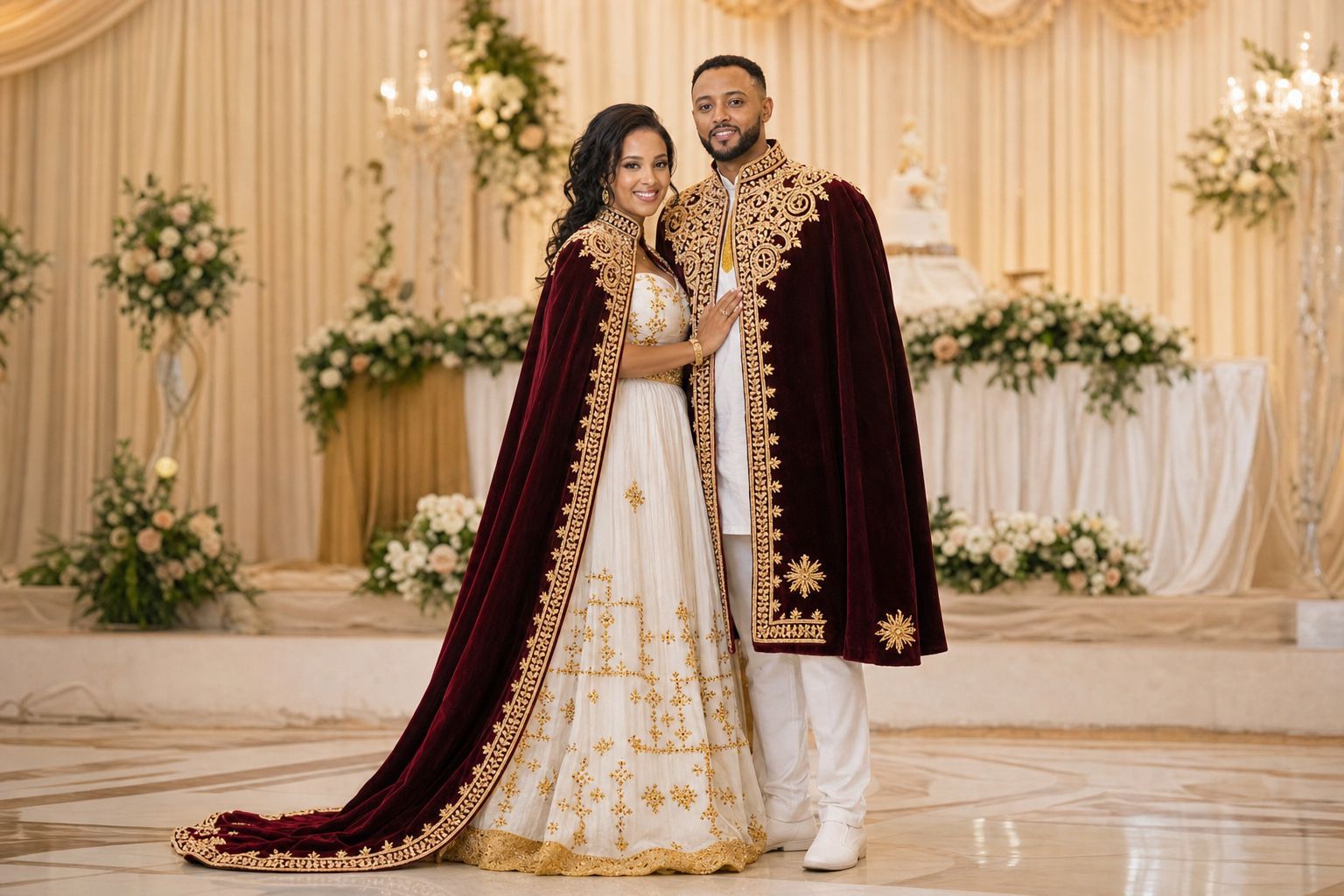
An illustrative family celebration, not a picture of one universal Ethiopian wedding custom.
Ask two Ethiopian families how a wedding should happen and you may receive two different schedules, two different guest lists, and two different definitions of simple. Language, region, religion, generation, city or rural setting, family resources, and diaspora experience all shape the event.
The useful way to understand an Ethiopian wedding is not to search for one national ritual. Look at four parts: the couple’s legal marriage, any religious ceremony, the role the families choose to play, and the public celebration.
Consent comes before tradition
The Ethiopian Constitution states that marriage must be entered with the free and full consent of the intending spouses. The Revised Family Code also sets legal conditions for marriage and recognises civil, religious, and customary forms.
This matters because family participation should not be confused with family control. Elders or relatives may introduce families, carry a proposal, mediate a disagreement, or speak during a gathering in some communities. Their involvement does not replace the consent of the couple.
Ethiopia’s federal Revised Family Code, Proclamation No. 213 of 2000, sets the minimum marriage age at eighteen for both women and men. Article 7 also allows the Minister of Justice to authorize marriage up to two years earlier than that for a serious cause, meaning the law does not permit marriage below sixteen even with that exception. Family law and registration are also administered regionally, so couples should still confirm the current law and procedure with the civil status office where they plan to register, since regional codes and practice can differ from the federal code. Public sources disagree about the current regional position in Afar and Somali specifically, so this article does not generalize about those two regions. Treat this as general information, not legal advice, and confirm the required documents, witnesses, notice period, and fees with the local office before relying on any of it.
Tradition is not a defence for coercion or child marriage.
There is no single order of events
A wedding process may include:
- A private decision by the couple
- Meetings between families
- An engagement or formal proposal
- Civil registration
- A religious ceremony
- A reception or meal
- A later family gathering
Some couples complete several parts on one day. Others separate them by weeks or months. A couple in Addis may combine a civil appointment, modern reception, and traditional clothing. A diaspora couple may hold one event abroad and another in Ethiopia.
Do not publish a fixed sequence unless it comes from the specific family or community being described.
Family meetings and elders
In some Ethiopian communities, respected elders or relatives help open formal discussions between families. In Amharic, people may refer to a respected elder as a shimagle, but the exact role, name, and process vary.
An elder may speak carefully on behalf of one family, ask for agreement, discuss practical expectations, or help calm tension. Modern couples may keep this element because it honours their parents, even when the couple chose each other and made the main decisions already.
Other families do not use a formal elder process at all. Some handle planning directly between the couple and parents. Intercommunity marriages may create a new process that takes something from both families.
The terms, speeches, gifts, and guest list for a formal family meeting vary enough that they are worth confirming with the actual family and community you are describing rather than assuming one script applies everywhere.
Civil, religious, and customary marriage are different layers
A celebration does not answer every legal question. Couples need to confirm how their marriage will be registered and which documents are required.
Addis Ababa’s Civil Registration and Residency Services Agency publishes a marriage registration service, including information for civil, religious, and traditional ceremonies. Requirements can change, and procedures may differ outside Addis.
Before planning a date, confirm:
- Identification documents
- Age and consent requirements
- Witness requirements
- Notice periods
- Evidence needed after a religious or customary ceremony
- Certificate collection
- Rules affecting a foreign national or diaspora document
Procedure, fees, and waiting periods change, so confirm the current version with the responsible woreda office or Ethiopian mission rather than planning a date around older information.
Ethiopian Orthodox weddings
For couples marrying in the Ethiopian Orthodox Tewahedo Church, matrimony is a sacrament. Church sources describe it as a covenant and use the idea of crowning in the service. The ceremony belongs to the faith, not to Ethiopian weddings in general.
Couples should speak directly with the priest well before the date. Church preparation, required documents, fasting or communion expectations, witness roles, clothing, and dates available for weddings must be confirmed locally.
Guests should dress modestly, arrive before the service begins, silence phones, and ask before taking photographs. A visually striking moment is still worship. Do not step into a sacred area or block the congregation for a camera angle.
Confirm the exact liturgical sequence and current parish requirements directly with the officiating church, since these can differ from one parish to the next.
Muslim weddings
Ethiopian Muslim wedding practice also varies by community, legal context, and family. The marriage contract and religious requirements should be discussed with the couple and their imam or relevant Islamic authority. Customs in Harar, Somali communities, Afar communities, Wollo, Jimma, Addis Ababa, and the diaspora should not be collapsed into one description.
A writer should distinguish religious requirements from local celebration. Clothing, food, gender arrangements, music, gifts, and length of the event can differ. Ask the family which details may be photographed or explained publicly.
Legal registration and religious documentation requirements are worth confirming with the couple’s imam or the relevant office rather than assumed from a general description like this one.
Protestant, Catholic, and other Christian weddings
Protestant and Catholic couples may have church services with vows, readings, music, prayer, and a reception, but denominations and congregations differ. Some families also include traditional clothing, elder blessings, or a separate home gathering.
Again, the church should explain its own preparation and ceremony. A general blog should not present one congregation’s practice as the Ethiopian Christian wedding.
Clothing can change during the day
At a contemporary wedding, the couple may wear western formal clothing, Ethiopian woven clothing, community specific dress, or several outfits. Family members may coordinate colours or textiles.
A bride may choose a white habesha kemis with woven or embroidered bands. A groom may wear a white tunic and trousers with a matching shawl. That look is associated with some highland traditions and modern national fashion, but it is not every Ethiopian couple’s heritage.
Ask:
- What does the couple want guests to wear?
- Does a garment belong to a specific community?
- Is a head covering expected at the religious venue?
- Will there be an outfit change?
- May photographs of preparation be shared?
Do not label clothing by ethnicity from appearance alone.
Food expresses hospitality, not one fixed menu
Many wedding receptions place strong emphasis on feeding guests well. The menu may include injera with meat and vegetable dishes, rice, bread, salad, cake, coffee, soft drinks, or food specific to the family’s community and religion.
Fasting calendars can affect an Orthodox menu or wedding date. Muslim families will consider halal requirements. Guests with allergies or dietary restrictions should ask rather than assume a dish is safe.
Buffet size is not a measure of the marriage. Families can feel pressure to host more people and provide more food than they can comfortably afford. A practical plan gives the couple and families a clear guest number, menu, serving method, and spending limit.
Ask the featured family to confirm the specific dishes served and what meaning, if any, they attach to them, rather than assuming a menu choice carries a fixed significance.
Music and dancing
Music may move between live traditional performance, regional songs, Ethiopian popular music, religious music, and international dance tracks. The mix depends on the family and venue. Some of the songs played are by well known Ethiopian musicians whose music has become part of how these celebrations sound.
Eskista is often mentioned in broad descriptions of Ethiopian dance, but it is linked especially to northern highland traditions and should not stand in for every community’s dance. Ask which music and dances the family identifies as its own.
Use licensed music in any published wedding video. A song played at a private reception is not automatically cleared for reuse on a blog or social platform.
A later family gathering
Some families hold another gathering after the main wedding. It may be called mels in some Amharic speaking contexts and can provide a more relaxed time for relatives, food, and another set of clothing.
The name, timing, purpose, and guest list differ. Some couples do not have this event. Treat it as one possible family practice, not a required final stage.
The spelling and contemporary use of mels vary between families, so check it with the people actually holding the gathering rather than treating one spelling as standard.
Guest etiquette
The invitation is the main guide. If the time, clothing, gift, or venue is unclear, ask a close family contact rather than guessing.
Useful habits include:
- Arrive on time for a religious service.
- Dress more modestly when the venue requires it.
- Do not enter family preparation rooms without invitation.
- Keep out of the path of elders, clergy, and working photographers.
- Ask before posting the couple, children, private prayers, or emotional family moments.
- Bring the gift in the form requested by the couple.
- Follow seating and food guidance without turning unfamiliar practice into a joke.
Large guest lists can make greetings brief. That is not necessarily rudeness. The couple may be managing hundreds of interactions.
Photography requires real permission
A hired photographer may have permission that a guest does not. Ask the couple what can be photographed and shared. Some religious moments may be restricted. Some relatives may not want to appear online.
Do not publish a cultural explanation based only on a photograph. Ask the people in the image what is happening and how they want it named. Remove children’s names and precise private locations unless the family specifically approves them.
Planning across two families or communities
Intercommunity and international weddings often require extra conversation. Write down which elements matter most to each person, which are religious obligations, which are family preferences, and which are optional.
Questions worth answering early include:
- Which legal registration will be used?
- Who is authorised to speak for the couple?
- Which ceremonies are essential?
- What languages will be used?
- How will clothing from both backgrounds be represented?
- What can the budget support without debt?
- Who approves photographs and public captions?
Compromise does not require pretending two customs are identical. A clear programme can explain each part in plain language.
The central idea
Many Ethiopian weddings give family and community a visible place, but the form changes. The honest explanation names the exact family, faith, location, and community instead of presenting one colourful reception as a national template.
Begin with consent and legal clarity. Let the couple and officiant define the ceremony. Ask the family how it understands its own customs. That is how a wedding guide becomes useful rather than decorative.