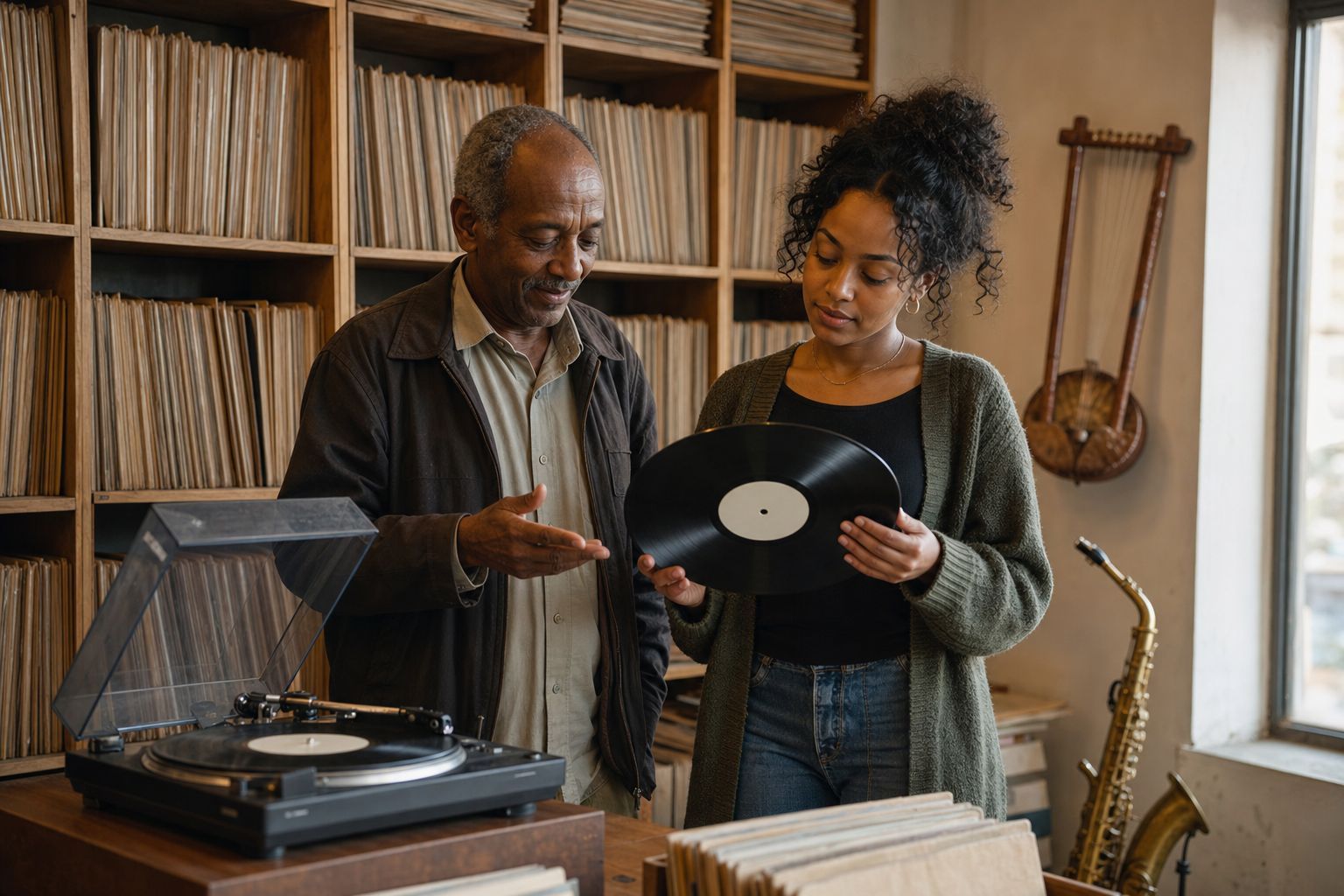
Original AI generated hero image representing one generation passing Ethiopia’s recorded music history to another.
A famous name is not automatically an important musical legacy. The more useful question is what changed because an artist sang, composed, arranged, recorded, or carried a sound to a new audience. Ethiopia’s musical history offers many answers: a voice that became part of public memory, a bandleader who joined old modes to new instruments, or a diaspora artist who made Amharic music feel at home in another city.
This is not a ranking, and it cannot represent every language or region. It is a beginner’s listening map built around artists whose influence is widely documented. Release dates below were checked against MusicBrainz, a community edited music archive, on 6 August 2026. That kind of archive is useful evidence of what was released and when, but it is not a final rights or songwriting credit authority, so where a specific writer credit is not noted below, treat it as unconfirmed rather than settled.
Tilahun Gessesse
Tilahun Gessesse is remembered as one of Ethiopia’s defining popular singers. His voice carried romantic songs, patriotic feeling, and public emotion with unusual force. Many Ethiopians know his work through family listening, radio, ceremonies, and national occasions rather than through one album.
His impact lies partly in interpretation. He could make a formal orchestral arrangement feel personal, and his phrasing helped establish expectations for later Amharic vocalists. References often describe him with honorific titles, but a careful article should explain his influence instead of relying on a grand nickname.
Start by listening for breath, the controlled rise of a phrase, and the way the orchestra leaves room for the words. A checked archive record supports several releases you can start with: the 1970 single “Yehagere Shitta,” the 1975 single “Sew Manen Yimeslal / Sima,” a 1975 album, and the 2003 “Éthiopiques 17” compilation. That record confirms the releases themselves. It does not establish who wrote each song, so do not assign specific songwriting credit to Tilahun Gessesse based on it alone.
Mahmoud Ahmed
Mahmoud Ahmed emerged from Addis Ababa’s modern popular music scene and became one of the most recognized voices associated with its golden era. His recordings combine intense Amharic singing with tightly arranged bands, horns, rhythm sections, and melodies that remain unmistakably Ethiopian.
International reissues later introduced his older recordings to listeners far beyond Ethiopia. That second life matters. It showed how an archive can change global understanding when recordings are properly restored, credited, and distributed.
For a beginner, compare a slow Mahmoud song with a faster dance number. The same singer can sound restrained in one track and urgent in another. Music in Africa and BBC Radio 3 have published useful biographical context. One detail worth getting right: the widely circulated “Éthiopiques 7” release is a 1999 reissue, not the year the songs were originally recorded, so do not describe 1999 as the recording date. Its own track credits list Mahmoud Ahmed as a writer on “Erè mèla mèla,” “Mètché nèw,” and other tracks, with co-writers including Sherefidin Moussa, Shèwalul Mengistu, and Abrar Abde on some songs. Other early career dates and recording credits still need archive checks.
Mulatu Astatke
Mulatu Astatke is closely associated with the creation and development of Ethio jazz. He studied music abroad, worked in New York, and brought Ethiopian modes into conversation with jazz, Latin rhythm, vibraphone, keyboards, horns, and percussion. The result was not Ethiopian melody placed on top of a generic jazz track. His strongest work makes both musical languages shape the arrangement.
His instrumental recordings also opened an accessible route for listeners who did not understand Amharic lyrics. Decades later, film use, reissues, touring, and collaboration brought the music to new generations.
The Library of Congress authority record identifies him as a Jimma born vibraphonist, composer, and jazz musician and documents his link with Ethio jazz. Listen first for the vibraphone, then for the bass line and horns. The Ethiopian character often sits in the melodic movement rather than in an obvious traditional instrument.
Alemayehu Eshete
Alemayehu Eshete brought dramatic stage energy to Ethiopian popular music. His recordings often carry soul, rock, and rhythm and blues influence while preserving Ethiopian melodic phrasing. He could sound playful, forceful, or emotionally raw, which made him a compelling performer as well as a studio singer.
International articles sometimes reduce him to a comparison with an American star. That shortcut may help a new reader imagine his stage presence, but it can also erase what was specifically Ethiopian about his work. Describe the voice, movement, band, and songs instead.
His place in the Addis recording era is well established. A checked archive record supports his performance on “Feqer Feqer New” and on the “Éthiopiques 9” collection, which covers recordings from 1969 to 1974. That record does not establish complete songwriter credits for him, so treat any specific writing credit you find elsewhere as needing confirmation through label notes or a reliable discography before you cite it.
Bizunesh Bekele
Bizunesh Bekele was a major female voice in Ethiopia’s modern popular music era. Her presence matters because simple histories of the period often center male singers and bandleaders. She performed with leading ensembles and recorded songs that remain important to listeners who grew up with Ethiopian radio and records.
Her impact is not only symbolic. She showed vocal control, emotional range, and a modern public performance style at a time when women artists faced limited space and documentation. A responsible profile should avoid filling archival gaps with guesses. Use record credits, broadcaster archives, and interviews where available.
Place one Bizunesh recording beside songs by male artists from the same period. Listen to how the arrangement supports her phrasing and how she changes the mood within a line.
Aster Aweke
Aster Aweke became one of the most visible Ethiopian women singers in the diaspora. Her powerful Amharic vocals connected listeners inside Ethiopia with communities abroad, especially during years when migration changed where Ethiopian music was recorded, performed, and sold.
Her influence can be heard in the expectations placed on later vocalists: technical strength, emotional projection, and the ability to command large stages. She also represents the way diaspora music can remain deeply Ethiopian without staying fixed in an earlier era.
A checked archive record supports albums in 1978, 1983, 1989, and 1991, including “Kabu” in 1991. The “Kabu” record includes performance and arrangement credits but not a complete set of writer credits, so do not overclaim that Aster Aweke wrote every track. When selecting examples, use official releases and check songwriting credits directly rather than assuming the singer wrote every song she performed.
Ejigayehu Gigi Shibabaw
Ejigayehu Shibabaw, widely known as Gigi, brought Ethiopian languages and melodic ideas into ambitious international studio production. Her work moved across acoustic instrumentation, jazz, electronic texture, and global collaboration without turning Ethiopian music into decoration.
Gigi’s impact is especially clear for listeners interested in arrangement. A voice may begin in a spacious setting and then meet bass, percussion, or layered production from musicians with different backgrounds. The result demonstrates that collaboration can expand a tradition when the singer’s language and musical identity remain central.
Check the language and translation of each selected song rather than labeling the whole catalogue Amharic, since her work includes more than one Ethiopian language and a general label can misrepresent a specific track. A checked archive record supports the albums “Gigi” (2001), “Zion Roots” (2003), “Gold & Wax” (2006), and “One Ethiopia” (2008). The “Zion Roots” record credits Gigi with lead vocals and production, Bill Laswell as producer, and Abegasu Shiota as additional producer, a specific detail worth using instead of a vague description of her role.
Hailu Mergia
Hailu Mergia is a keyboard and accordion player linked with the Walias Band and Ethiopia’s influential instrumental music scene. His work is a useful reminder that singers are not the only people who shape popular memory. Arrangers, instrumentalists, and band members build the sound around the voice and can create lasting work without one.
Later reissues and renewed touring brought his music to younger audiences. The story is appealing, but it should not be romanticized as a simple discovery by outsiders. Ethiopian listeners and musicians carried knowledge of this music before international press returned to it.
Listen for organ or keyboard texture, rhythmic patience, and the way an instrumental melody can feel conversational.
What these musicians changed
These artists did not all work in the same genre. Their shared importance comes from several kinds of impact.
- They expanded the expressive possibilities of Ethiopian popular singing.
- They connected Ethiopian melodic modes with modern band arrangements.
- They preserved language and memory across migration.
- They made space for women as central recording and stage artists.
- They helped Ethiopian records circulate through reissues, film, touring, and archives.
- They influenced younger musicians who now work in Ethiopia and across the diaspora.
Impact also depends on listeners. A song becomes part of a wedding, a taxi ride, a family gathering, or a difficult period in someone’s life. That social history is harder to document than chart performance, but it is often more meaningful.
Build a fair listening list
Do not begin with a list of twenty names and one track each. Choose four artists and listen to three recordings by each. Include at least one woman, one instrumentalist, one golden era singer, and one diaspora artist. Read the credits. Note the recording year, band, language, and legal source.
Then widen the map. Seek important Oromo, Tigrinya, Gurage, Somali Ethiopian, Afar, and southern artists with guidance from speakers and community sources. This article’s focus on widely archived Amharic and Addis connected musicians reflects what is easiest to document in English, not a judgment that other traditions matter less.
Use official artist pages, licensed streaming services, Smithsonian or library collections, and label catalogues. Avoid channels that upload whole albums without clear rights. If you share a short social clip, credit the musician, composer where known, recording, and legal source.
Common mistakes
The first mistake is calling every artist an Ethio jazz musician. Mahmoud Ahmed, Aster Aweke, and Tilahun Gessesse are not interchangeable with Mulatu Astatke. The second is assigning a song to its singer without checking the composer, lyricist, arranger, and band. The third is repeating dates from unsourced fan pages.
Images need the same care. A famous musician’s portrait is normally copyrighted. Use a press image only when its license clearly permits the blog’s intended use, request permission, or choose an original archive concept like the hero above.
Continue listening
Begin with one voice, one instrumentalist, and one artist from a later generation. Follow the credits outward to band members, composers, and regional traditions. That method produces a richer education than a popularity ranking.
For the broader map of modes, instruments, sacred sound, azmari performance, and regional traditions, read our beginner guide to Ethiopian music genres. The two guides work best together: one explains the musical landscape, and this one gives you people to follow through it.