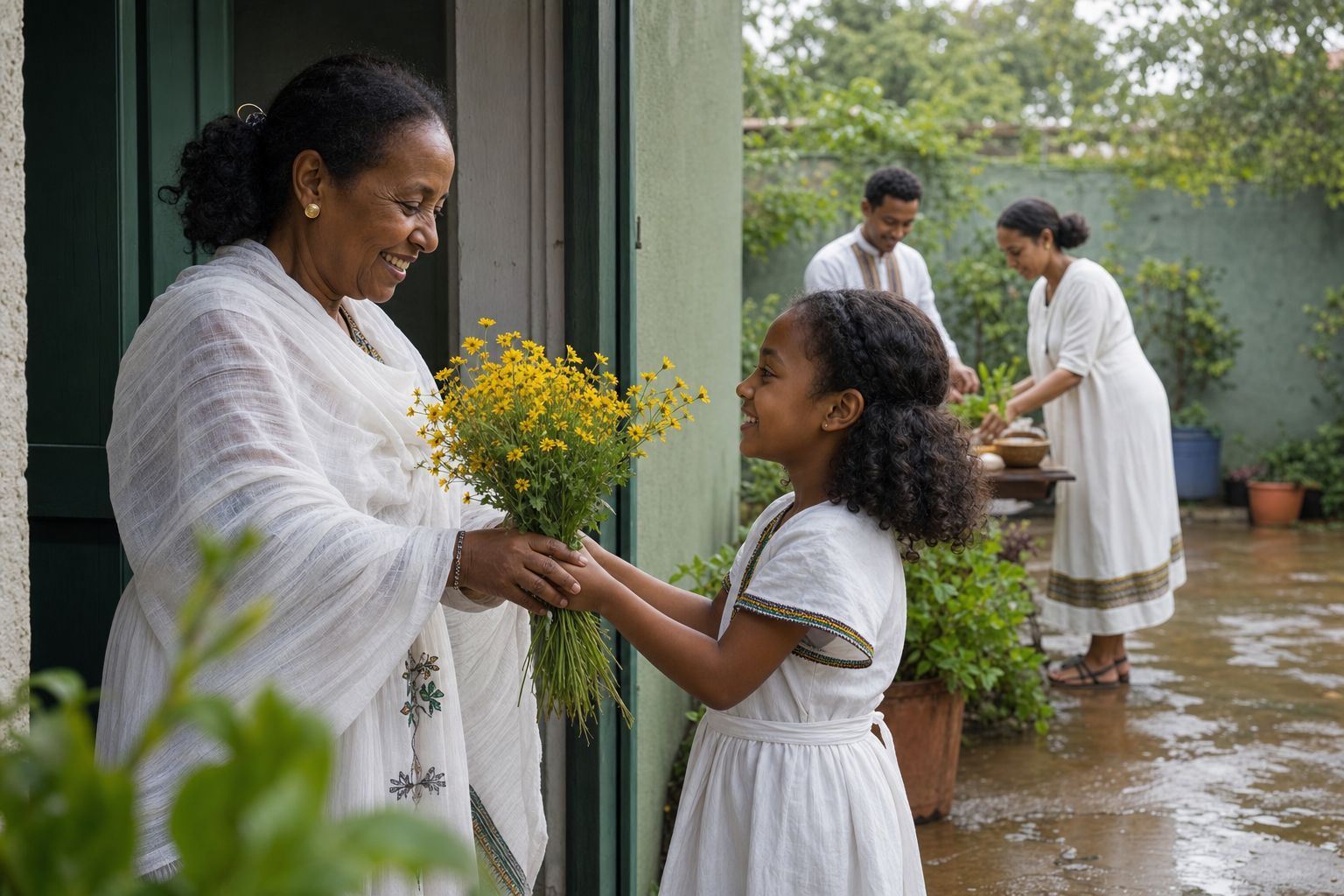
 Adey Abeba flowers carry the feeling of renewal into the Ethiopian new year.
While much of the world counts the new year from January, Ethiopia welcomes its own on September 11 (September 12 in the year before a Gregorian leap year). It is one of several holidays covered in the beginner’s guide to Ethiopian holidays, but it deserves its own closer look. The holiday is called Enkutatash, and its timing is not arbitrary. It arrives as the long summer rains end and the highlands burst into green, scattered with bright yellow daisies. After weeks of grey and wet, the new year comes with sunshine and flowers, which tells you a lot about the mood of the day.
Why September, and what the name means
Ethiopia’s calendar runs several years behind the Gregorian one and has thirteen months, twelve of thirty days each and a short final month of five or six days, so the year turns in what is, for most of the world, early September rather than the middle of winter. The name Enkutatash means “gift of jewels.” By tradition, when the Queen of Sheba (Makeda in Ethiopian) returned from her visit to King Solomon in Jerusalem, her people welcomed her home with jewels, and the name has carried that meaning ever since. The day now marks renewal and the fresh start that comes with the end of the rains, and it lands close enough to the end of the rainy season that the two ideas, a new year and a new, greener season, feel like the same event rather than a coincidence.
The flowers: Adey Abeba
The symbol of the season is the Adey Abeba, the small yellow daisy that covers the highlands at this time of year. You will see the flowers everywhere, and their color runs through the celebration, from decorations to clothing. For many people the sight of the first Adey Abeba is the real signal that the new year, and the good weather, has arrived.
The days before the holiday
Enkutatash does not arrive without notice. In the week or so before it, households do a real cleaning push, sweeping out the old year along with the dust, and many families paint or freshen a wall, buy new clothes, and stock up on the ingredients for the feast. Markets get busy with people buying live chickens for doro wot, spices, and fresh flowers. If you are in Addis in early September, this build up is itself a sign the new year is close, even before the actual date arrives.
How it is celebrated
Enkutatash blends the religious and the domestic:
- New clothes, often traditional white cotton with colorful woven borders, are common, especially for children.
- Family gatherings and a feast, frequently featuring doro wot and injera (see the beginner’s guide to Ethiopian food if those are new to you), bring people together.
- Bonfires may be lit on the eve in some places, a bright farewell to the old year.
- Children go door to door, singing New Year songs and sometimes offering small pictures drawn by hand or bunches of Adey Abeba, and receiving small gifts or money in return.
- Church services mark the day for many families.
It is a warm, hopeful holiday, more about family, renewal, and the turn of the season than spectacle.
The church service
For many Ethiopian Orthodox families, the day starts before sunrise with a service at the local church. People often dress in white for it, the traditional color for a church visit, and the service itself is a chance to give thanks for the year that just ended and ask for a good one ahead. After church, the focus shifts to home: families return to start the feast, and it is common for households to visit each other through the rest of the day, moving from one relative’s table to the next.
Not every family centers the day on church in the same way. Some treat the religious observance as the anchor of the whole holiday, while others put more weight on the family meal and the visiting that follows it. Both are normal, and neither is the “correct” version of the day.
In the city and in the countryside
Enkutatash looks a little different depending on where you are. In Addis Ababa and other cities, the day tends to center on the household: a cleaned home, a table set for the feast, and visits to and from relatives and neighbors across the day. Children still go door to door in many neighborhoods, though the practice is more common in some areas than others.
In rural areas, especially where cattle herding is part of daily life, Enkutatash can carry an added layer tied to the end of the rainy season itself: fresh grass for animals, swollen rivers beginning to recede, and a countryside that has visibly turned green. The Adey Abeba daisies that give the holiday its color are, in a very literal sense, a rural signal before they become an urban decoration, since they bloom across the highlands before anyone brings a bunch of them into a city home.
The songs children sing
Part of what makes Enkutatash recognizable, even from a distance, is the sound of it. Groups of children, often girls, go from house to house singing traditional new year songs, sometimes known as Abebayehosh, while carrying handfuls of Adey Abeba or small hand drawn pictures. The songs are cheerful and repetitive, built for a door to door visit rather than a formal performance, and the household being visited is expected to respond with a small gift of money, food, or both. If you hear singing outside in early September, this is very likely what is happening, and it is a normal, welcome part of the season rather than something to be wary of.
If you want to take part
- Accept invitations. Being welcomed to a family’s New Year meal is a genuine honor.
- Bring a small gift if you visit someone’s home.
- Dress nicely, and modestly if you are attending church.
- Learn a greeting. A simple “Melkam Addis Amet” (happy new year) goes a long way.
- Ask before photographing people, especially at church.
- Have some small change ready if children come singing to your door. A small amount is the point, not a large sum.
Common mistakes
- Assuming it is on January 1. It is in September.
- Treating the date as fixed. Confirm it for the specific year.
- Turning up with nothing in hand to a home celebration.
- Missing the meaning by focusing only on the festivities. It is a season of renewal after the rains.
- Assuming every family marks the day exactly the same way. Church emphasis, food, and how much of the day is spent visiting others all vary by household.
- Confusing Enkutatash with Meskel, the holiday that follows about two weeks later. They are related in timing but distinct in meaning.
Bottom line
Enkutatash is Ethiopia’s new year, arriving in September with sunshine, yellow daisies, new clothes, and family feasts after the long rains. The days before it are as much a part of the holiday as the day itself, cleaning, buying new clothes, and preparing the feast, and the sound of children singing door to door is one of the clearest signs the new year has actually arrived. If you are here for it, learn the greeting, accept an invitation, and enjoy one of the most hopeful days on the calendar. For the wider festival year, see the holidays guide.