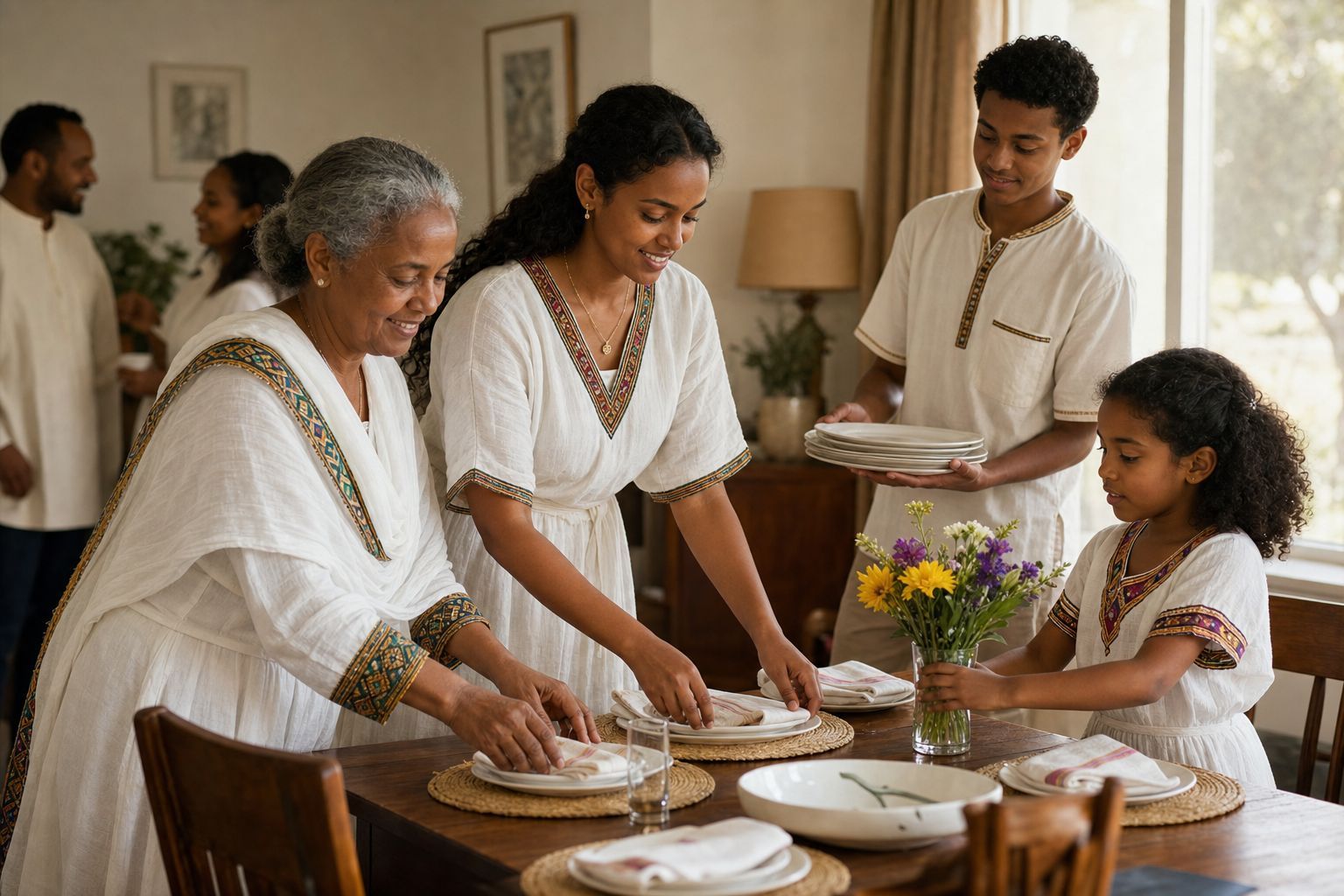
 Many Ethiopian holidays are understood most clearly through the family preparations around them.
Ethiopia keeps its own calendar and its own new year, so the holiday dates here will look unfamiliar at first. Once you understand the rhythm, though, the year has a clear and colorful shape, with major religious and cultural festivals that shut the city down, fill the streets, and are genuinely worth planning around.
A quick note on dates: Ethiopia uses its own calendar, which runs several years behind the Gregorian one and has thirteen months. The main fixed holidays land on the same Gregorian days most years, shifting by a single day around Gregorian leap years, before settling back the year after. The movable religious feasts, Fasika and the Muslim holidays, move each year like Easter does elsewhere. So the fixed dates below are reliable, and you should confirm the movable ones for the specific year.
The calendar behind the dates
The Ethiopian calendar has thirteen months: twelve of thirty days each, plus a short thirteenth month, Pagume, of five days, or six in a leap year, which is sometimes described locally as “the thirteenth month of sunshine.” This is part of why the Ethiopian year runs several years behind the Gregorian one; the two calendars calculate the date of the Annunciation differently, and that gap carries through everything else. It is also why the new year falls in September rather than January. Once you know this, the rest of the calendar stops feeling random. Most public life still runs on the Gregorian date for everyday scheduling, but holidays, church life, and often people’s stated age or birth year follow the Ethiopian calendar, so it is worth asking which one someone means if a date matters.
Enkutatash: Ethiopian New Year
Enkutatash marks the new year and falls on September 11 (September 12 in the year before a Gregorian leap year). The name translates roughly to “gift of jewels,” tied to a tradition about the Queen of Sheba’s return from Jerusalem. It comes at the end of the long rains, when the highlands turn green and yellow with wildflowers, particularly the small yellow Adey Abeba daisy that becomes a symbol of the season. Expect new clothes, family meals built around doro wot, children going door to door singing and sometimes handing out flowers, and often church services in the morning. See the full guide to Ethiopian New Year for the meaning and traditions behind it in more depth.
Meskel: the Finding of the True Cross
Meskel falls on September 27 (a day later in the year before a Gregorian leap year) and commemorates the finding of the True Cross. Tradition holds that Empress Helena located the cross after locals guided her to the spot by following the smoke of a bonfire, and that story is why fire is central to the celebration today. Its signature is the Demera, a large bonfire topped with a cross, built from tall branches and lit before big crowds, most famously in Meskel Square in Addis. Yellow Adey Abeba flowers, the same ones tied to Enkutatash, are often woven into the display, since the two holidays sit close together on the calendar. The full Meskel guide covers the ceremony and respectful visitor planning.
Genna: Ethiopian Christmas
Genna (Ethiopian Christmas) is celebrated on January 7, since the Ethiopian calendar’s date calculation lands Christmas here rather than in December. It follows a fasting period and is marked by church services, often overnight, and family meals afterward, frequently featuring doro wot. In some places it is associated with a traditional field game also called genna, played with curved sticks and a wooden ball, similar in spirit to hockey, though you are more likely to see it referenced in stories and art than actually played in a city setting today.
Timket: Epiphany
Timket celebrates the baptism of Christ and is one of the grandest festivals of the year, on January 19 (January 20 in a leap year). Replicas of the Ark (the tabot) are carried in procession from churches, wrapped in ornate cloth and carried on the heads of priests under colorful ceremonial umbrellas, accompanied by chanting, color, and crowds. Blessed water features prominently: a pool or body of water is blessed overnight, and at dawn people are sprinkled with or immerse themselves in it, a renewal of baptismal vows. Gondar, with its historic castles, is especially well known for a large and elaborate Timket celebration if you are looking for one particular place to see it. The Timket beginner guide explains the sequence from procession to water blessing.
Fasika: Ethiopian Easter
Fasika (Easter) is a movable feast that follows a long fast, and it is one of the most important religious holidays of the year, arguably outranking Genna in significance for many Orthodox Christians here. The fast leading up to it runs for roughly fifty five days, longer than Lent in many other traditions, during which observant fasters avoid meat and dairy entirely. The date changes every year, so check the current year’s calendar; it is marked by overnight services that run into the early morning, and then a large family meal, often the first meat eaten in weeks, to break the fast.
Muslim holidays
Ethiopia has a large Muslim population and a long Islamic history, particularly in the east: the city of Harar is one of the oldest and most significant centers of Islam in the region, walled and historic, and often mentioned alongside Mecca and Medina in terms of religious importance to Ethiopian Muslims. Eid al-Fitr marks the end of the fasting month of Ramadan and is typically celebrated with special prayers, new clothes, and family meals, similar in spirit to how Enkutatash and Genna work for Christian communities. Eid al-Adha commemorates a story of sacrifice and obedience shared across the Abrahamic faiths, and is often marked by the sacrifice and sharing of an animal, with meat distributed to family, neighbors, and those in need. Mawlid (the Prophet’s birthday) is also observed. All three follow the lunar Islamic calendar, so their Gregorian dates move about 10 to 11 days earlier each year. Confirm them annually.
National and civic days
Alongside the religious calendar are civic holidays, led by Adwa Victory Day on March 2, marking the 1896 victory at the Battle of Adwa, a defining moment in the country’s history and a source of real national pride, since it was a decisive win against a colonial invasion at a time when most of the continent was being carved up by European powers. Others include Labour Day, Patriots’ Day, and the Downfall of the Derg; check the current year’s official calendar for the full list. These civic days tend to be quieter than the big religious festivals, marked more by closures and official ceremonies than by street celebration, though Adwa Day is an exception in cities with a strong sense of its history.
Confirming the exact date each year
The fixed holidays above are reliable from year to year, but the movable ones are not, and getting a date wrong is an easy mistake for anyone new to the calendar. A few ways to confirm:
- Ask locally, close to the date. Colleagues, neighbors, or hotel staff will know the current year’s date for a movable feast well before it arrives.
- Check the Ethiopian Orthodox Church’s own announcements for Fasika and related dates, since the church calculates and publishes these.
- Check the national or a regional government’s public holiday calendar for the official list, which usually comes out well in advance for planning purposes.
- Local news, especially close to the holiday, will cover the date and any public guidance, particularly for the larger festivals.
Do not rely on a foreign website’s Ethiopian holiday list without a recent date, since these calendars shift enough year to year that an old list can be wrong by days. If you are trying to plan travel around a specific festival, build in a buffer of a day or two on either side rather than booking to arrive on the exact expected date, in case your source turns out to be slightly off.
What holidays mean for a visitor
- Closures. Government offices, banks, and many businesses close on major holidays. Plan errands around them.
- Travel and crowds. Big festivals draw huge crowds and fill transport and hotels, especially in cities famous for a particular celebration. Book ahead.
- Dress and respect. For religious festivals, dress modestly, especially near churches, and ask before photographing people or ceremonies.
- Fasting seasons. Long fasting periods before Genna and Fasika change what many restaurants serve. Fasting food becomes widespread.
- Noise and timing. Overnight church services mean chanting and singing can carry late into the night and start again before dawn near churches. It is normal, not a disturbance, but worth expecting if you are staying nearby.
- An invitation is a real honor. If an Ethiopian friend or colleague invites you to their home for a holiday meal, it is a meaningful gesture, not a casual one. Accept if you can, bring a small gift, and expect to be fed generously.
- New clothes matter more than they might seem to. Around Enkutatash and other major holidays, buying new clothes, especially traditional wear for children, is a genuine part of the tradition, not just a pleasant extra. Do not read it as vanity if a family spends carefully on this.
- Coffee will likely be part of it. A holiday gathering often includes a full coffee ceremony at some point, on top of the meal itself. Budget the time for it rather than trying to leave early.
The same instinct, dressing well, gathering family, budgeting real time for it, shows up at other major life events too, like Ethiopian wedding traditions.
Celebrated well beyond Ethiopia’s borders
If you know Ethiopians living abroad, you will likely see these same holidays celebrated there too, often with real effort put into recreating the food, music, and sense of gathering even far from home, sometimes in a rented hall or community center rather than a private house simply because of how many people want to take part. Enkutatash and Meskel especially are marked by diaspora communities in cities with a sizable Ethiopian population, sometimes as public cultural events rather than only private ones. If you cannot make it to Ethiopia for a particular holiday, asking around locally wherever you live is often worth it.
Common mistakes
- Assuming the Gregorian date is fixed. Confirm the exact day for the year.
- Scheduling official errands on a holiday and finding everything closed.
- Turning up to a major festival city without booking transport and a room.
- Photographing ceremonies or people without asking.
- Confusing the Ethiopian and Gregorian calendars when someone tells you a date or an age. Ask which calendar they mean if it matters.
- Assuming every holiday is a public spectacle. Many are quiet, family and church centered occasions rather than street festivals, and it helps to know which kind you are walking into.
Bottom line
Ethiopia’s year is organized around a calendar of its own and a set of festivals that are among the most vivid you will see anywhere. Learn the big ones, Enkutatash, Meskel, Genna, Timket, and Fasika, plus the Eids, Mawlid, and Adwa, and confirm each year’s exact dates before you plan around them. Understand the thirteen month calendar behind the dates, why it runs its own count of years, and the rest of the calendar starts to make sense on its own rather than looking like a list of arbitrary exceptions to memorize. Then plan around the closures, dress and behave respectfully near churches and mosques, and where you can, go and take part rather than just watch from the side. The deeper guides linked above cover the biggest festivals in full, with more detail than a single overview can hold.