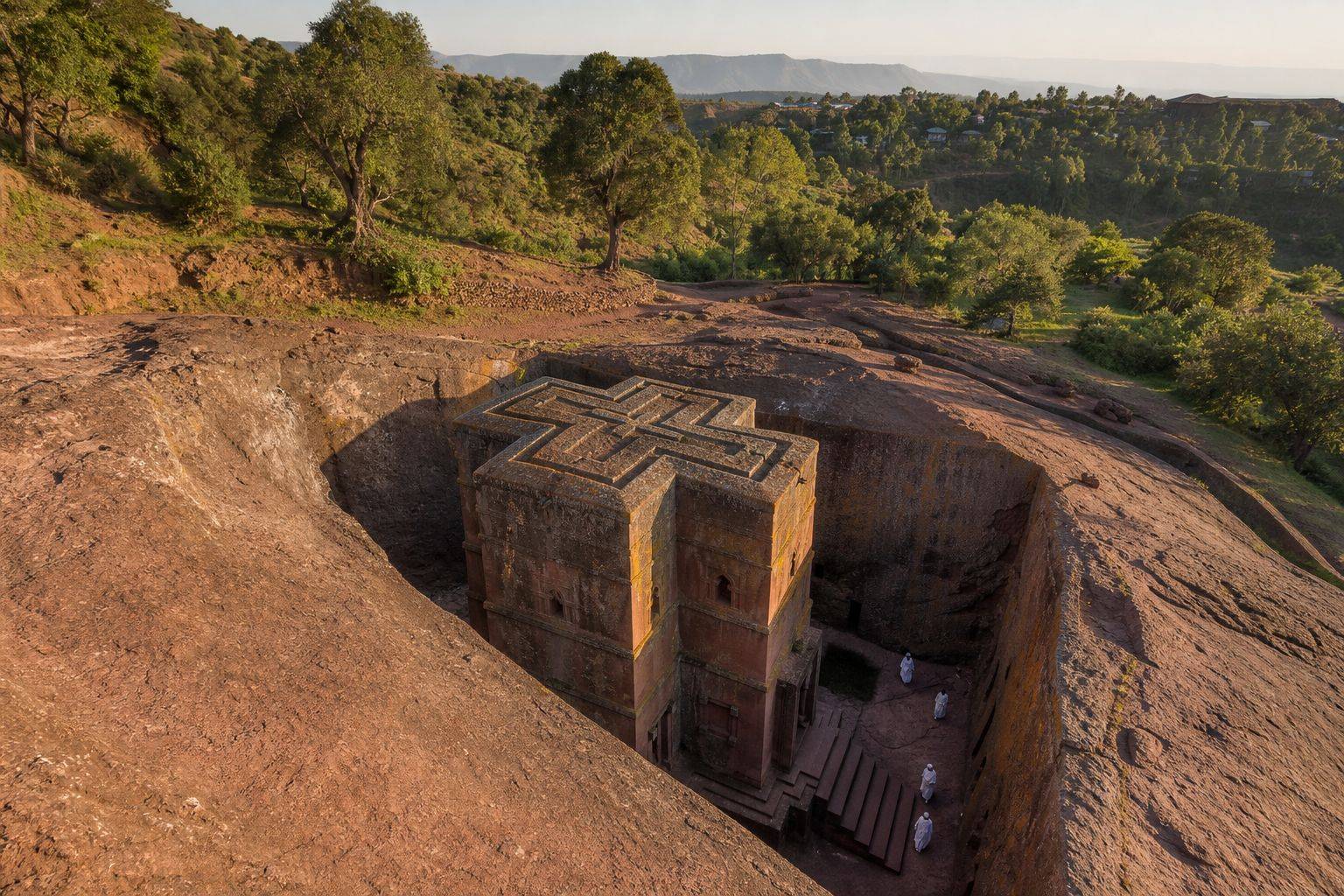
 Biete Ghiorgis is carved downward from living rock. Lalibela’s churches remain active places of worship, not abandoned monuments.
Lalibela is easier to understand from inside a trench than from the famous overhead viewpoint. At ground level, the rock becomes wall, doorway, roof, drainage channel, passage, and church. A few steps can move you from hard highland sunlight into a dark interior where a service is still taking place.
The town is home to eleven medieval churches recognized by UNESCO as a World Heritage property. They are usually associated with King Lalibela and a plan for a sacred landscape recalling Jerusalem. The churches are still used by priests, pilgrims, and local congregations.
For a broader comparison of sites and routes, see Best Historical Places to Visit in Ethiopia.
That living role shapes every practical decision. A ticket allows access to a heritage site. It does not turn prayer into a performance or open every sacred space to photography.
Current safety note
Lalibela is in Amhara Regional State. As of 6 August 2026, both the United Kingdom and the United States currently say do not travel there. The UK’s live advice recommends against all travel to the whole of Amhara because of armed conflict, roadblocks, detention risk, crime, and rapidly changing conditions. The US advisory, dated 1 April 2026, rates Ethiopia overall Level 3, Reconsider Travel, and separately tells the public, not only its own government employees, not to travel to Amhara among other regions.
UNESCO reported that an official delegation visited Lalibela’s main church groups on 3 and 4 July 2026. That confirms professional and official access happened on those specific dates. It does not confirm unrestricted public tourist access, and this guide does not treat it that way. UNESCO’s conservation record also shows ongoing conservation work at the site, with alternative shelter options still under study. That does not establish a current closure to visitors either, so avoid both extremes: do not claim the churches are closed, and do not claim normal unrestricted access is currently available.
Check the latest advice from your own government, Ethiopian authorities, airlines, insurers, and trusted local contacts before booking, since flights, roads, communications, and access can all change with little notice. This guide is useful for future planning and for readers already assessing the site. It is not advice to travel against an official warning. If an advisory says do not go, postpone the trip.
Why the churches are unusual
The churches were hewn from rock rather than built upward with separate stone blocks. Workers cut down around large masses of volcanic rock, then shaped exterior walls, windows, columns, doors, roofs, and interiors. Other structures were cut into rock faces or connected through passages.
UNESCO groups the churches on two sides of a watercourse named Jordan. The northern group includes Biete Medhani Alem and Biete Mariam. The southern group includes Biete Amanuel and several connected structures. Biete Ghiorgis stands apart and is linked through trenches.
The symbolic names and layout encourage comparison with the Holy Land, but the churches also belong to Ethiopian architectural and religious history. A knowledgeable guide should explain both without reducing every feature to one simple legend.
The churches to notice first
Biete Medhani Alem creates a strong first impression through its size and rows of exterior columns. Walk around it before entering so you can see how the mass was separated from the surrounding rock.
Biete Mariam often feels more intimate. Interior decoration, carved details, and the surrounding courtyard reward a slower visit. Services and private prayer may limit movement at any time.
Biete Amanuel has a carefully articulated exterior that recalls earlier Aksumite architectural forms. Its shape is a useful reminder that Lalibela did not appear without older Ethiopian building traditions.
Biete Ghiorgis has the familiar cross shaped plan visible from above. The best experience combines that first view with the descent into the trench. Do not step onto the roof or cross barriers for a photograph.
Other churches and connected spaces matter to the complete landscape. A first visit should not become a race to four names. Let access, worship, conservation work, and your guide’s route determine the order.
How do I get there
Ethiopian Airlines maintains a route page for flights between Addis Ababa and Lalibela, and the airport sits about 25 kilometres from town. A route page existing is not proof of a current daily flight, so confirm the actual schedule directly with the airline close to your travel date.
By road, the Ethiopia Ministry of Tourism gives a distance from Addis Ababa of roughly 680 kilometres, travelling via Dessie and Weldiya. Treat that figure as geographical context only. This guide does not publish a fixed drive time for that route, and it does not recommend the road as an option while Amhara remains under a do not travel advisory. Base any transport decision on your own government’s current guidance and a direct check with the airline, not on a distance figure alone.
How much time to allow
Two full days offer a sensible first visit when travel is safe.
On the first day, explore one main church group in the morning and the other later in the day. Heat, altitude, uneven paths, and repeated shoe removal make a rushed schedule tiring.
On the second day, return to details you missed, spend longer at Biete Ghiorgis, and consider an excursion to a nearby church only after checking the route and current safety. Some surrounding monasteries require steep walking or a vehicle journey.
Three days work better if you want quiet observation, church services, photography from approved areas, or a demanding outer excursion. During Genna, Timket, or other major feasts, add time and expect access to follow worship rather than visitor convenience. Confirm the festival dates and any change to church access for the year you plan to travel.
A practical two day outline
Day one can begin early with the northern group. Morning light and cooler air make the trenches easier to walk. Pause for lunch and rest, then visit the southern group with enough time to leave before dark.
Day two can focus on Biete Ghiorgis, the museum if open, and a careful second look at one church group. Add an outer church only if a registered guide, safe transport, weather, and your fitness all support it.
Keep the sequence flexible. A service, funeral, festival rehearsal, conservation closure, or security instruction can change access. That is normal at a living religious site.
Guide, ticket, and opening arrangements
Use an authorized local guide. The physical network is confusing, but navigation is only part of the value. A good guide distinguishes church tradition from archaeological interpretation, explains restricted spaces, and knows when a service should not be interrupted.
Entrance fees, guide rates, ticket validity, opening hours, and camera rules can change, so confirm all current charges and official guide arrangements directly with the site authority rather than relying on a price copied from an old travel forum.
Pay at official points and keep the receipt. Agree on the guide service and total fee before starting. Ask if any church or museum requires a separate ticket.
Church etiquette
Dress modestly. Cover shoulders and knees. Remove shoes whenever instructed, often before entering each church. Clean socks make this repeated routine easier.
Men and women may be directed to different areas in some churches. Follow the instruction without arguing. Do not enter the sanctuary or step behind curtains.
Keep your voice low. Turn off flash and camera sounds. A service takes priority over a visitor route. If worshippers are receiving communion, praying, or meeting a priest, wait outside or move to another church.
Ask before photographing a person, even when the wider site permits photography. Priests holding crosses, manuscripts, or umbrellas are not props. Do not offer money for a photograph unless an established local arrangement is explained clearly by your guide.
Walking conditions and accessibility
The church route includes worn steps, narrow passages, low light, steep edges, and uneven rock. Some trenches become slippery during rain. Handrails are limited.
Visitors with limited mobility should ask the site authority and guide which viewpoints and churches are realistically accessible. A driver may reduce walking between groups, but the deepest trenches and many interiors still require steps.
Bring a small light if allowed, though never shine it at worshippers or delicate paintings. Move slowly when your eyes adjust from bright sun to a dark interior.
Altitude may affect visitors arriving directly from lower places. Drink water, rest, and avoid an intense first afternoon. Seek medical advice before travel if you have a condition affected by altitude.
Best time of day and season
Morning generally offers cooler air, clearer energy, and more comfortable walking. Late afternoon can produce attractive light around the rock, but do not remain in trenches after the official closing time.
Season affects rain, road conditions, dust, and landscape colour. Major religious festivals offer profound public worship but also bring crowds, full accommodation, restricted movement, and higher demand for transport.
There is no honest permanent answer for the best month without current weather and security context. Check recent rainfall, road reports, festival dates, and local advice for the year you plan to travel before settling on a season.
What to pack
- Modest layers for church entry
- Warm outer layer for cool mornings and evenings
- Comfortable closed shoes with reliable grip
- Clean socks for repeated shoe removal
- Sun hat and sunscreen
- Water bottle
- Small light if current rules allow
- Essential medicine and basic first aid
- Charged phone and power bank
- Secure copy of identification
Keep luggage simple. Large camera bags are awkward in narrow passages, and tripods may not be allowed.
Food, accommodation, and local spending
Accommodation ranges and restaurant availability can change sharply when transport or security is disrupted. Confirm that a property is operating before paying. Ask about power, hot water, meal availability, and airport transfer rather than assuming.
Try local food through established restaurants or a trusted host. During Orthodox fasting periods, plant based dishes are widely available. If you have allergies, explain them clearly and confirm ingredients rather than relying only on a menu label.
Hire locally, buy directly from identified makers, and pay agreed rates. Avoid purchasing manuscripts, crosses, icons, or objects presented as old. Genuine antiquities may be protected cultural property, while convincing copies can be misrepresented. Choose clearly modern crafts and request a receipt.
Photography that helps rather than harms
The strongest Lalibela photographs show scale, carved depth, and human use without intruding on prayer.
Use wide views from established paths. Include people only when they are distant or have agreed. Avoid flash inside churches. Do not touch walls or lean equipment against carved surfaces.
Drone use requires legal permission and site approval. Do not launch one casually over churches, worshippers, or security areas.
The generated hero image in this draft is an illustration. Replace it with a real authorized photograph before publishing if possible, because Lalibela is a specific living place.
Common mistakes
- Visiting only Biete Ghiorgis
- Treating every explanation as settled archaeology
- Entering a church without removing shoes
- Using flash around paintings and worshippers
- Walking onto roofs or beyond barriers
- Scheduling both church groups and an outer monastery in one rushed day
- Publishing old prices or opening hours
- Buying an object represented as an antiquity
- Assuming an open flight means the whole journey is safe
- Ignoring altitude, rain, and uneven walking
Plan the trip you can actually complete
When safe access returns, give Lalibela at least two days and keep them flexible. Use an authorized guide, visit the church groups slowly, and let services change your route. Prepare for steps, darkness, altitude, and repeated shoe removal.
Most importantly, separate desire from access. Lalibela will remain historically and spiritually important even when travel must pause. Waiting for reliable safety conditions is not missing the site. It is the responsible way to make a future visit possible.