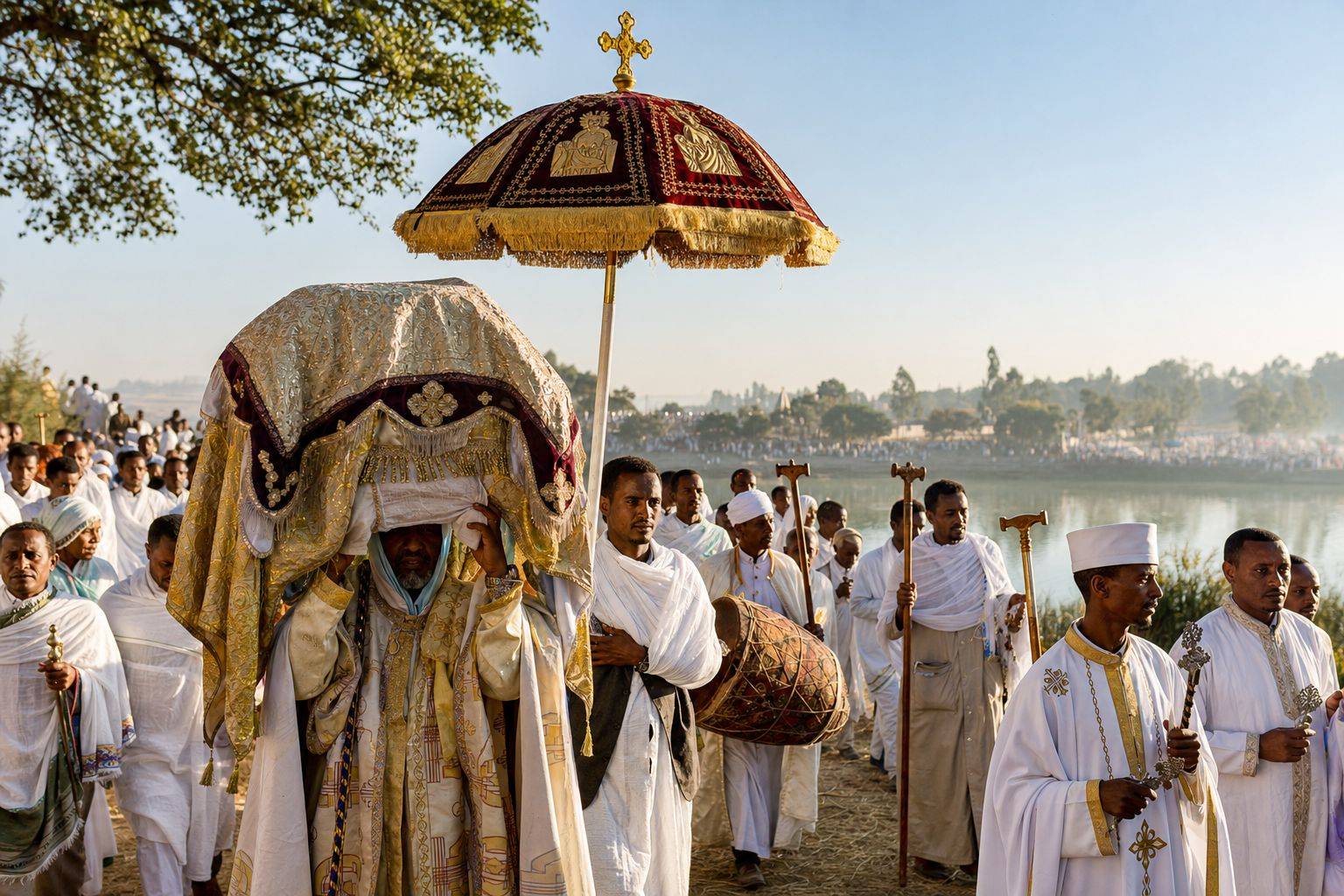
 A priest carries a covered tabot during Timket. The sacred object remains wrapped and should never be treated as a display.
Timket is not a single parade that begins and ends in a few hours. It is a sequence that starts with parish processions, continues through a night of prayer beside water, reaches its central moment before and after sunrise, then follows each church community home.
The festival commemorates the baptism of Jesus Christ in the River Jordan. It is one of the most important public feasts of the Ethiopian Orthodox Tewahedo Church and one of the clearest examples of worship moving from church grounds into streets and shared public space.
Visitors are often drawn by white clothing, embroidered vestments, colourful umbrellas, drums, chanting, and crowds. Those details matter, but the heart of Timket is the tabot and the blessing of water.
What Timket means
Timket is the Ethiopian celebration of Epiphany. The feast remembers the baptism of Christ by John the Baptist. Water therefore has a central place in the ceremony, not as entertainment but as a sign of baptism, blessing, and renewal.
UNESCO added Ethiopian Epiphany to the Representative List of the Intangible Cultural Heritage of Humanity in 2019. Its description emphasizes the role of clergy, church communities, processions, prayers, sacred music, and the return of each tabot to its parish.
The scale differs across Ethiopia. Addis Ababa brings many parish groups together at Jan Meda. Gondar is widely associated with a major gathering around Fasilides Bath. Aksum and other cities have their own settings and rhythms. Local practice should guide any description of a specific celebration.
The tabot and why respect matters
A tabot is a sacred altar tablet associated with the Ark of the Covenant. Each Ethiopian Orthodox church has one. During Timket, it is carried from the church by clergy, completely covered in rich cloth and often shaded by a ceremonial umbrella.
The covering is not decoration hiding an object that visitors are supposed to see. The tabot itself is sacred and is not displayed publicly. Do not attempt to look beneath the cloth, photograph underneath it, touch it, or ask someone to reveal it.
When a tabot passes, worshippers may bow, pray, sing, or make the sign of the cross. Step aside and leave a clear path. Never walk between the priest carrying it and the accompanying clergy. If you are unsure where to stand, ask a steward or copy the respectful distance kept by nearby families.
When Timket takes place
For the next occurrence, Ketera falls on Monday, 18 January 2027, and Timket itself is Tuesday, 19 January 2027, according to the Ethiopian Orthodox Tewahedo Church and UNESCO’s own listing for Ethiopian Epiphany. Calendar rules can move the Gregorian date in other years, so confirm the exact dates for your year of travel through the Church and current local announcements rather than assuming the usual pattern holds.
Ketera begins the public movement. Parish communities escort their tabots from their churches toward a body of water, pool, or prepared reservoir known as Timkete Bahir. The procession may start in the afternoon and continue for hours.
What happens during Ketera
Ketera provides time to understand each church community as a group. Clergy wear ceremonial vestments. Deacons and choirs sing. Drums, sistrums, and prayer staffs accompany the movement. Large umbrellas mark the position of sacred objects and senior clergy.
People may sweep or prepare the route before the procession arrives. Families join from side streets. White cotton shawls create a visual unity, while the embroidery and vestments around clergy add strong colour.
Once the tabots reach the water site, they are placed in protected ceremonial tents or another prepared sacred space. Worship continues through the night with prayers, hymns, and liturgy. Visitors should not enter clergy areas or assume that an open public site means every space is open.
The water blessing
The main rituals begin before sunrise. Clergy pray over the water and a cross may be immersed as part of the blessing. Worshippers are then sprinkled with blessed water. Some participants may enter the water in places where local practice and conditions allow it.
This moment is frequently described too casually as a water celebration. It is better understood as a public act of blessing tied to baptism. Visitors should not splash others, jump into the water for a photograph, or turn the ceremony into a party.
At a large gathering, the front area can become crowded. A distant position may be safer and more respectful than pushing toward the water. Follow barriers and instructions. Keep camera equipment close and avoid flash.
The return processions
After the blessing and later ceremonies, each tabot begins its journey back to its own church. This return can be the most energetic part of Timket. Singing, drumming, dancing, and calls between groups accompany the route.
The celebration is not over simply because the water blessing has finished. Following one parish group from a respectful distance can show how the large shared gathering becomes local again. Do not block the route or walk immediately in front of clergy.
In some traditions, one tabot remains for an additional observance connected with the Wedding at Cana, though the local practice and terminology vary, so check with the parish or a local host before including it in a location specific account.
Where a first time visitor might attend
Addis Ababa is usually the most practical option for a visitor already in the capital. Jan Meda hosts a major gathering, and several neighbourhood churches have their own visible processions. The January 2027 routes, road closures, gates, prohibited items, and the specific Jan Meda programme are not settled at the time of writing and are not covered here. Check the city administration, police, the Church, and the venue itself close to the date rather than relying on this article for operational details, since plans can change from year to year.
Gondar is famous for Timket around Fasilides Bath, but the specific 2027 Gondar programme, security arrangements, and venue rules are not verified here and should not be assumed from past years. Travel conditions in Amhara have also been volatile. As of July 29, 2026, the United Kingdom travel advisory recommends against all travel to Amhara Regional State. Other governments also apply strong restrictions.
Do not treat an annual festival as proof that a destination is safe for visitors. Check your own government’s advice, insurance rules, local official guidance, and recent transport conditions. If official advice recommends against travel, plan for a future year rather than trying to work around it.
What to wear
Dress modestly and prepare for changing temperature. A January afternoon can feel bright and warm, while the hours before sunrise can be cold.
Useful clothing includes:
- A shirt that covers the shoulders
- Trousers or a long skirt suited to walking
- A warm layer for the night and early morning
- Comfortable closed shoes
- A light rain layer if the forecast suggests it
Visitors do not need to wear white traditional clothing to show respect. Ordinary modest dress is enough. Avoid clothes chosen mainly to imitate clergy or worshippers.
What to carry
Bring as little as possible because you may stand and walk for a long time.
- Charged phone and small power bank
- Water and a simple snack
- Essential medicine
- Secure copy of identification
- Small amount of money
- Warm layer
Large camera bags, tripods, and loose valuables are difficult in a dense procession. Do not carry a drone unless you have clear legal permission and event approval.
Photography and personal space
Wide public scenes can usually be photographed from designated areas. Close portraits require permission. This is especially important for children, people receiving blessed water, and anyone in prayer.
Never use flash near the tabot, clergy, or water blessing. Do not hold a camera above a covered tabot to see what is beneath the cloth. Do not ask worshippers to repeat a sacred gesture. If someone declines a photograph, accept the answer immediately.
Timket produces striking images, but the visitor’s right to a photograph never comes before a person’s worship.
Crowd, transport, and health planning
Road closures and large crowds can make normal journeys much longer. Arrange transport before the event, identify a pickup point outside the densest area, and expect to walk.
Agree on a meeting point with companions. Mobile service may be slow. Keep children close. If crowd pressure increases, move toward a quieter side area rather than forcing your way forward.
Long hours outdoors require water, food, sun protection, and warmth. Do not enter water if the area is not open to visitors, if you cannot judge its depth, or if local health advice makes contact unsafe.
Current security conditions can change quickly. Religious gatherings can also attract additional security measures, so review official notices and travel advice immediately before attendance rather than relying on how a previous year’s event went. For the details this article does not cover, gates, security arrangements, and prohibited items among them, check city notices, police, the Church, and the venue itself rather than a single travel calendar.
A simple first visit plan
For a first Timket, consider attending part of Ketera in daylight, then returning before sunrise for the blessing if transport and security arrangements allow. This gives you the procession, the overnight atmosphere, and the morning ceremony without requiring you to remain in a dense public area all night.
Choose one parish group or one edge of the main venue rather than trying to see everything. Ask a trusted local person to explain what is happening. Their guidance is more useful than moving constantly for photographs.
After the water blessing, leave time for the return procession. Watch how worshippers make space for the covered tabot and how the music changes as groups begin the journey home.
Common mistakes
- Calling Timket an Ethiopian carnival
- Describing the tabot as a decorative box
- Trying to see or photograph beneath its covering
- Arriving only for the water and missing Ketera
- Pushing toward clergy or the blessed water
- Wearing party clothing to a sacred event
- Entering water without invitation or safety information
- Assuming Gondar is safe because the festival is scheduled
- Publishing a fixed route or time from a previous year
- Photographing children and worshippers without permission
The point to remember
Timket joins movement, prayer, water, music, and parish identity in one long ceremony. The tabot leaves the church under careful protection, the community spends the night near water, the blessing recalls baptism, and the procession brings the sacred object home.
A respectful visitor does not need access to the closest position or every ritual. Arrive informed, give worshippers room, and let the sequence unfold. The result is a much clearer understanding of Timket than any collection of colourful photographs can provide on its own.