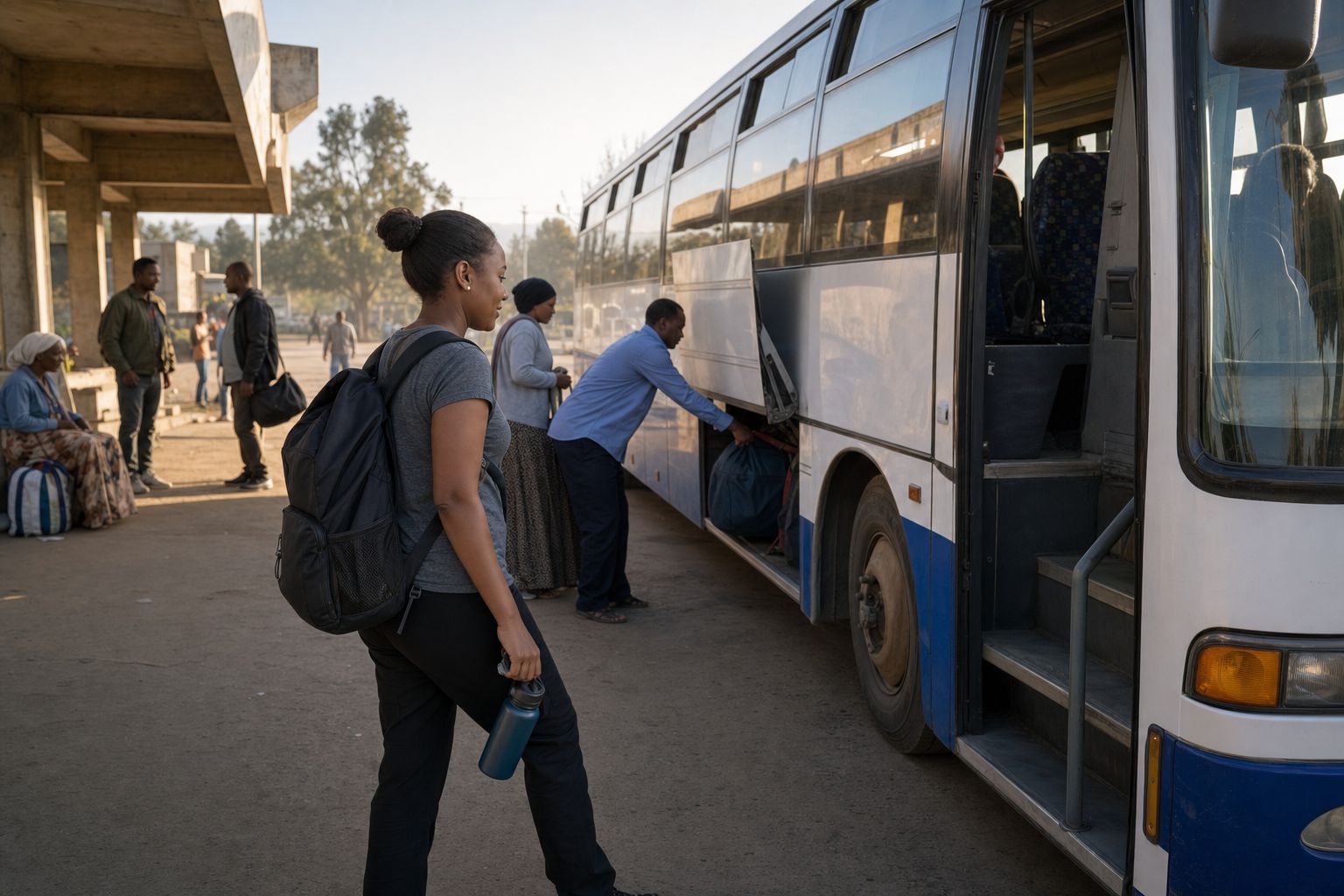
An illustrative scene of a traveler preparing to board an intercity bus in Ethiopia.
The cheapest ticket is not always the cheapest journey. A very early departure may require a taxi across Addis. A room far from the centre may add two rides every day. A low tour price may exclude entry, food, guide service, or the return trip.
Budget travel in Ethiopia works best when you control the expensive decisions first: distance, route, transport type, and number of stops. Daily food and small purchases matter, but they rarely rescue an itinerary that spends half its time moving between distant regions.
All prices and operating details change. This guide therefore focuses on a method, not a list of numbers that may be wrong next month.
Build the budget in seven parts
Before booking anything, divide the trip into:
- Long distance transport
- Local transport
- Accommodation
- Food and drinking water
- Entrance and guide fees
- Communication and practical supplies
- Emergency reserve
Give each part a realistic amount. Then add a reserve that you do not plan to spend. Delayed vehicles, a changed route, illness, or a missed connection can turn a narrow budget into a serious problem.
Write prices in Ethiopian birr and in your home currency if you are visiting from abroad. Exchange rates move, so record the date of every conversion, and confirm the current exchange rules and rates with an authorised bank or exchange service rather than an old figure you saw online.
Travel fewer routes and experience them properly
Ethiopia is large. Lalibela, Gondar, the Simien Mountains, Harar, the Omo Valley, and the Danakil Depression do not fit naturally into one short cheap trip. Joining distant points may require domestic flights, long road journeys, specialist vehicles, or organised tours.
A lower cost itinerary usually has one geographical focus. You might base yourself in Addis Ababa and take a nearby weekend trip, or choose one historic northern route when current access allows. Fewer bases mean fewer transfer days, fewer rushed bookings, and less money spent reaching terminals.
Count nights, not just destinations. If a road journey uses most of a day, that day still needs food, local transport, and accommodation. A map can make two places look close while terrain and road conditions make the transfer slow.
Compare the complete transport cost
Public buses and shared vehicles can cost less than private transport, but they require flexibility. Departure points may be outside the area where you are staying. Luggage rules, ticket systems, routes, and schedules need a current local check.
For every option, compare:
- The fare
- Transport to and from both terminals
- Luggage charges
- Food during the journey
- The value of the time used
- The risk of arriving after dark
- The cost of a room if a connection fails
A domestic flight can sometimes protect a short itinerary from losing a full day, but the price, baggage allowance, and schedule must be checked directly with the airline. A private driver can make sense for a small group if the total is divided fairly and the quote includes fuel, driver allowance, parking, and waiting time.
Avoid road travel after dark. Current official advice also warns that transport and security conditions outside Addis can change. Check the exact route shortly before departure, not only when you begin planning.
Choose accommodation by total daily cost
A room should be judged with its location and basic services. Ask these questions before paying:
- Is breakfast included?
- Is safe drinking water available?
- Can the property store luggage?
- Is there reliable hot water?
- How far is it from the bus station or the places you will visit?
- Can the property arrange a trusted early taxi?
- What is the cancellation rule?
A slightly higher room price can save money if you can walk safely to meals and attractions. A cheaper edge of town room may require repeated rides.
Ask to see the room when booking in person. Check the lock, window, bathroom, bedding, and noise. If paying online, use a platform or property contact you can verify. Do not send a deposit to a personal account based only on a message from an unknown profile.
Room rates and any tax added on top change often enough that you should confirm them directly with the property before you build them into a budget.
Eat local without treating hygiene as optional
Local restaurants and fasting food can offer satisfying meals at a lower cost than hotel dining. A beyaynetu, shiro, firfir, or simple pasta dish may stretch a budget while still giving you a real part of daily food culture.
Choose busy places where food turns over. Ask whether the water is treated, and use sealed bottled water or properly boiled water when you are unsure. Fresh fruit you can peel is easier to judge than cut fruit that has been sitting in the open.
Do not skip meals to save a small amount before a long drive or hike. Carry water and a simple snack. Remote attractions may have no reliable shop, and buying the first available item can cost more than preparing in town.
Food prices vary by city, neighbourhood, restaurant level, and season, so treat any sample daily food budget as a starting point to test against real menus rather than a fixed figure.
Manage cash carefully
Ethiopia remains heavily dependent on cash, especially outside larger city businesses. Card terminals and cash machines may be limited or unreliable. Carry enough for the next part of the route, but do not keep all of it in one wallet.
Use authorised banks or licensed exchange services. Keep exchange receipts. Do not build a travel budget around an informal rate, since laws and enforcement can change and the legal risk is not worth a claimed saving. Banks and authorised dealers now set or negotiate rates under the current market framework rather than a single fixed official rate, so compare before committing to a large exchange.
Practical cash habits include:
- Split money between two secure places.
- Keep smaller notes ready for ordinary purchases.
- Count change without making a display of your wallet.
- Confirm the price before a ride or service begins.
- Record larger spending each evening.
Cash declaration and currency rules are genuinely unsettled right now, and different official sources do not agree. A February 2026 amendment from the National Bank of Ethiopia cancelled the earlier requirement to declare foreign currency above USD 10,000, or the equivalent, for exchange, deposit, and border entry purposes. However, the National Bank’s own older public guidance still shows the earlier USD 10,000 declaration threshold, and some current government travel guidance repeats that older rule too, so a traveller can get conflicting answers depending on which source they check.
Separate from that, the birr limit has not changed. The underlying rule caps the Ethiopian birr a traveller may carry into or out of the country at 3,000 birr, or 10,000 birr for travel to or from Djibouti and other neighbouring port cities.
Anyone carrying a substantial amount of cash should confirm the current operational procedure directly with the National Bank of Ethiopia and Ethiopian Customs before travelling, and follow the instructions given by officers at the border, since the written rule and the public guidance about it do not fully agree at the moment.
Decide when a guide is worth the cost
A good guide is not only someone who repeats dates. At a historic, religious, or natural site, a guide may help with access, local etiquette, route finding, language, and safety. Some places require an official guide or organised tour.
Before agreeing, ask:
- What does the fee include?
- Is transport separate?
- Are entrance and community fees separate?
- How long is the service?
- Is the guide authorised where authorisation is required?
- May you leave if the route or conditions change?
Do not avoid a required guide to save money. Instead, reduce the number of guided attractions and choose the ones where interpretation adds the most value. A shared group tour can lower the cost, but confirm the group size and itinerary.
Use your phone to prevent expensive mistakes
Download maps before leaving reliable coverage. Save the address and phone number of your accommodation in both English and the local script if available. Take screenshots of bookings, but keep personal details out of public view.
A local SIM or data package can help with navigation and contact, but prices and coverage vary. Downloading the route, translation notes, and essential documents means a temporary network interruption does not stop the trip.
Carry a power bank, yet remember that batteries do not replace planning. Tell a reliable person where you are going and when you expect to arrive.
Bargain with context and respect
Negotiation is common in some markets and informal transport settings, but not every price is an invitation to bargain. Restaurants, ticket offices, formal shops, and many hotels usually have set prices.
Ask calmly, compare like with like, and walk away politely if the amount does not fit. Do not push an artisan to a price that removes the value of their labour. A meaningful saving on a handmade item should not depend on treating the maker’s time as worthless.
For taxis or informal rides, agree on the fare and destination before moving. If a meter or app is used, confirm how the final price is calculated.
Protect the emergency reserve
The reserve is for a real change, not for an extra souvenir. It should cover at least one safer room, a replacement journey, food and water during a delay, and a way to contact help. The right amount depends on the route and the traveller, so work it out against your own itinerary rather than copying a fixed number from a guide like this one.
Travel insurance is also part of a responsible budget for international visitors. Read the exclusions. A policy may not cover areas under an official warning, high altitude trekking, evacuation, or an activity booked with an unapproved operator.
A simple planning sequence
Start with current security information. Remove unsuitable regions. Choose one geographical focus, then compare the full transport cost. Book the first night and any limited service that genuinely requires advance booking. Leave some space for changes.
The evening before each move, confirm:
- The departure point and time
- Current route conditions
- The expected arrival before dark
- Accommodation contact
- Cash and water
- A backup if the transport does not operate
Saving money should make the trip more sustainable, not more fragile. Spend less by travelling fewer routes, sharing fair costs, eating simply, and checking details. Do not save by ignoring safety, permits, or basic health.