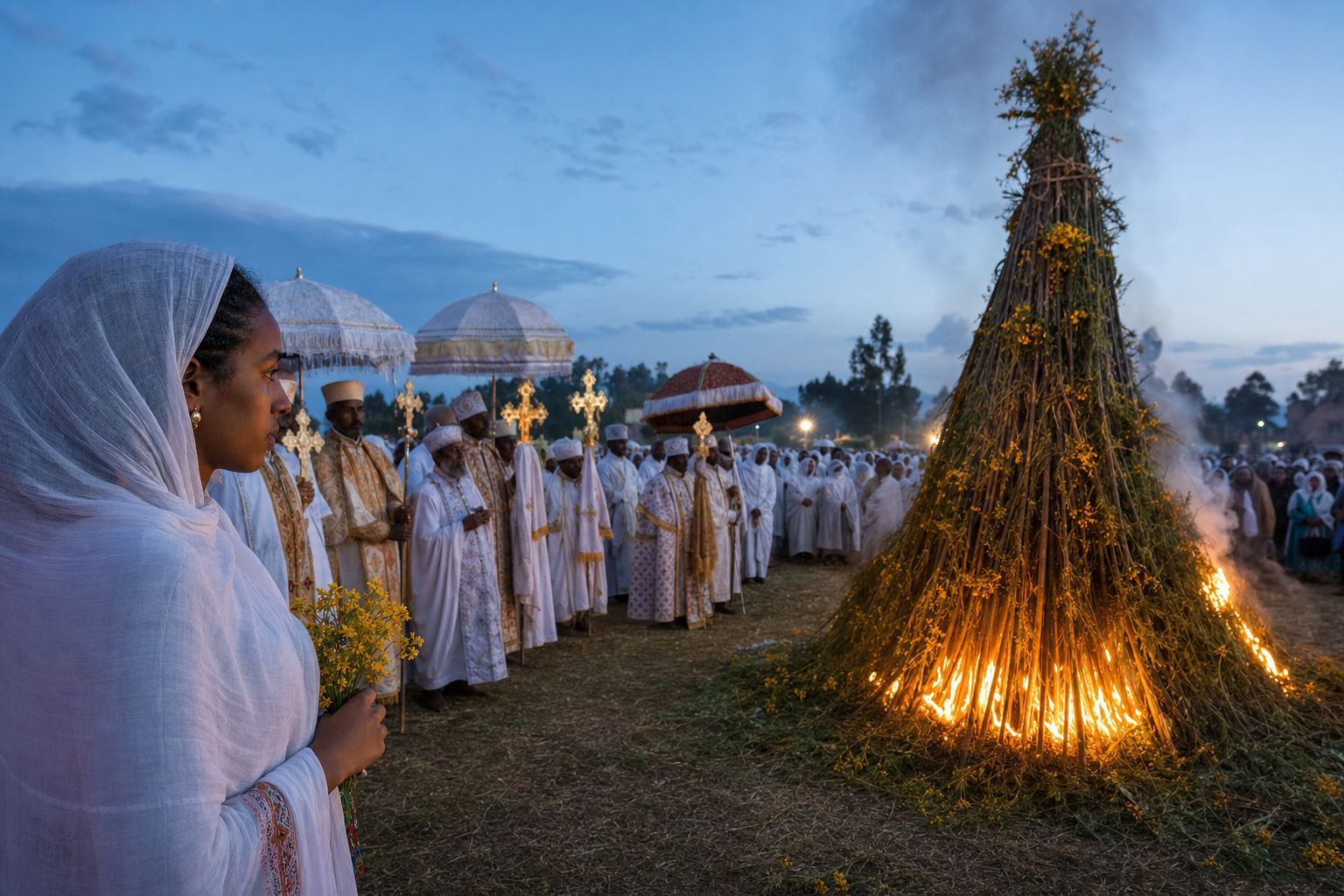
 A Demera bonfire forms the public centre of Meskel celebrations. The ceremony is religious first, even when visitors attend.
Long before the fire is lit, the shape of Meskel is already visible. Fresh grass, yellow Adey Abeba flowers, bundles of branches, white shawls, church umbrellas, and crowds moving toward a shared gathering place all signal that the feast is close.
Meskel commemorates the finding of the True Cross in Ethiopian Orthodox Christian tradition. The best known public event is the lighting of the Demera, a tall conical bonfire built in church yards, town squares, and neighbourhood gathering places. Addis Ababa holds the largest public ceremony at Meskel Square, but the celebration belongs to communities across the country.
For a visitor, the fire is the most dramatic image. For worshippers, it is one part of a feast shaped by prayer, memory, reunion, and reconciliation.
A broader guide to Ethiopian holidays places Meskel beside other major observances.
What Meskel means
The word Meskel means cross in Amharic. The feast remembers a Christian tradition about Saint Helena, also known as Empress Helena, and her search for the cross on which Jesus was crucified. In the tradition, smoke helped reveal where the cross was buried. The Demera recalls that story through fire and rising smoke.
Meskel is especially important within the Ethiopian Orthodox Tewahedo Church, though its public presence reaches beyond church walls. Families gather. People return to their home areas when they can. Neighbours help prepare local ceremonies. In some communities, disagreements are settled before the feast. That link between spiritual observance and social repair is one reason Meskel remains meaningful beyond the spectacle of the bonfire.
UNESCO placed the commemoration on the Representative List of the Intangible Cultural Heritage of Humanity in 2013. That recognition applies to the living knowledge, practices, and community participation around the feast, not simply to one large event in Addis Ababa.
When Meskel is celebrated
The next occurrence is expected on Saturday, 26 September 2026, when the Demera bonfire is lit, followed by the Feast of the Finding of the True Cross on Sunday, 27 September 2026. That date comes from the Ethiopian Orthodox Tewahedo Church’s own published material. Ethiopian calendar and Gregorian calendar differences mean the date is not fixed from one year to the next, so confirm the exact dates and programme for the year you plan to travel with the Church, the relevant city administration, or recent local notices rather than an old travel calendar.
Preparations often begin earlier. Local groups collect wood and branches, construct the pyre, decorate the area, rehearse hymns, and organize access around the ceremony. The public gathering can occupy much of the afternoon and evening.
How the Demera ceremony unfolds
Details vary by place, but the broad sequence is recognizable.
First, the community constructs a tall pyre from poles, branches, and bundles of kindling. Fresh grass and yellow flowers may be added. The shape is deliberate. It is not an ordinary campfire and should not be described as one.
Clergy, Sunday school groups, choirs, and worshippers gather around the site. Priests and deacons may carry processional crosses, prayer staffs, sistrums, drums, and ceremonial umbrellas. Hymns, prayers, and rhythmic movement build slowly rather than beginning with the fire itself.
At the appointed point, the Demera is blessed and lit. Flames rise from the base and move through the structure. People watch the smoke and the direction in which the central structure falls. You may hear interpretations about what that direction means for the coming year. Those interpretations can differ between communities, so ask rather than presenting one explanation as universal.
After the public ceremony, observance continues through church services, household meals, and visits. In some places, people later mark themselves with ash from the fire as a sign connected to the cross, though this varies by community, so ask a local host about the practice before describing or joining it.
Meskel in Addis Ababa
Meskel Square offers the largest and most visible public ceremony. It can be a powerful introduction because the scale makes the procession, church music, and Demera easy to see as one coordinated event.
The scale also creates practical difficulties. Roads may close. Walking routes can change. Security checks and crowd barriers may affect where people enter. Mobile service can become unreliable when many people use the network at once. Leaving may take longer than arriving.
The exact lighting time, stage programme, gates, road closures, security perimeter, and prohibited items for the Meskel Square ceremony are not fixed here because they change year to year and even source to source. A government ministry event page has, in past years, given a different day for the lighting than the Church’s own announcements. Do not treat any single source, including this article, as the final operational programme. Check the Church, the city administration, and same day local notices together, and expect them to be updated closer to the event.
If you plan to attend, check official notices on the same day. Arrive well before the fire lighting, keep valuables secure and out of sight, carry little, and agree on a meeting point with companions in case you become separated. A hotel or trusted local contact can help you understand the current access plan.
Do not assume the closest possible position is the best one. A slightly more distant view often gives you a clearer sense of the ceremony and an easier exit. Stay outside barriers, follow instructions and police barriers, and leave the area if crowd movement ever feels unsafe.
Meskel beyond the main square
A neighbourhood or town ceremony can feel more intimate because the people preparing the Demera often know one another. You may see children bringing branches, residents decorating the site, and families greeting relatives who have returned for the feast.
Smaller does not mean informal. A church yard Demera remains a religious event. Ask a local host where visitors should stand and when photography is appropriate. Do not walk between clergy and the bonfire, move objects placed for the ceremony, or treat the gathering as a backdrop for posed portraits.
Regional customs and foods also vary. Gurage communities, for example, are strongly associated with major Meskel homecomings and festive meals. It is better to name a specific custom only when a local source confirms it than to flatten many regional practices into one national menu.
What to wear and bring
Modest, practical clothing works best. Shoulders and knees should be covered near churches and clergy. White clothing is common among worshippers, but visitors do not need to imitate ceremonial dress. Clean, simple clothes show more respect than a costume chosen for photographs.
Evenings in Addis Ababa can become cool after sunset. Wear a light warm layer and closed shoes that can handle dust, grass, and long periods of standing.
Bring only what you can keep close:
- A charged phone
- A small bottle of water
- A light warm layer
- Essential identification carried securely
- A small amount of money stored out of sight
- Any medicine you may need during a long event
Avoid large bags, valuable jewellery, and equipment that blocks another person’s view. If you bring a camera, use a simple setup you can control in a crowd.
Photography without disrespect
The bonfire and wide crowd scene may be photographed from approved public areas. Individual people deserve more care. Ask before taking a close portrait, especially of children, clergy, or someone praying.
Do not use a flash during prayer. Do not push forward during a procession for a better angle. Never ask clergy to repeat a gesture. Avoid drones unless you have explicit legal permission and event authorization. Large public gatherings often have security restrictions that make casual drone use inappropriate or illegal.
The safest rule is simple: observe the ceremony first, then decide if a photograph can be made without interrupting it.
Fire and crowd safety
A Demera is a large open fire surrounded by many people. Keep the distance set by organizers, even if others appear to move closer. Wind can carry sparks and smoke. The central poles can fall as the structure burns.
Know where you will exit before the lighting. Keep children close. If the crowd begins pushing, move sideways toward a less dense area instead of forcing a direct path through it. Follow official instructions quickly.
Current security conditions can change. Check your government’s Ethiopia travel advice, local news, and city notices before attending a major gathering, and confirm the security guidance and road closures on the day of the event itself rather than assuming last year’s arrangements still apply.
Family meals and home invitations
Public fire images dominate online coverage, but much of Meskel happens at home. A family invitation may include a long meal, coffee, conversation, and relatives arriving at different times.
If invited, ask your host what time you should come and whether you can bring anything. Fruit, coffee, or a simple household gift may be suitable, but local advice is better than a fixed rule. Let your host guide seating, serving order, and prayer.
Do not arrive with assumptions about a single Meskel dish. Food depends on region, household, fasting practice, budget, and family preference. If you write about the meal later, use the names your host gives you and confirm spelling.
Common mistakes
- Calling Meskel only a fire festival and ignoring its Christian meaning
- Confusing the public Demera evening with the complete feast
- Arriving shortly before the lighting and expecting easy access
- Standing inside a procession route
- Taking close photographs without permission
- Wearing clothes suited to a party rather than a religious gathering
- Treating one regional food or custom as universal
- Leaving without a meeting point or transport plan
- Publishing an old date or road plan without checking the current year
A practical way to attend
Start by choosing one setting: the major ceremony at Meskel Square, a local church event with a host, or a town celebration you can reach safely. Confirm the date, access, and transport close to the event. Arrive early enough to see preparation and prayer, not only the flames.
During the ceremony, watch how local worshippers move and follow their lead without copying sacred actions you do not understand. Keep your camera secondary. Afterward, allow time for a slow exit and, if invited, for the quieter family side of the feast.
Meskel makes the most sense when fire, faith, and community are seen together. The Demera is memorable, but the deeper story is the work of gathering, remembering, and repairing relationships before a new season begins.