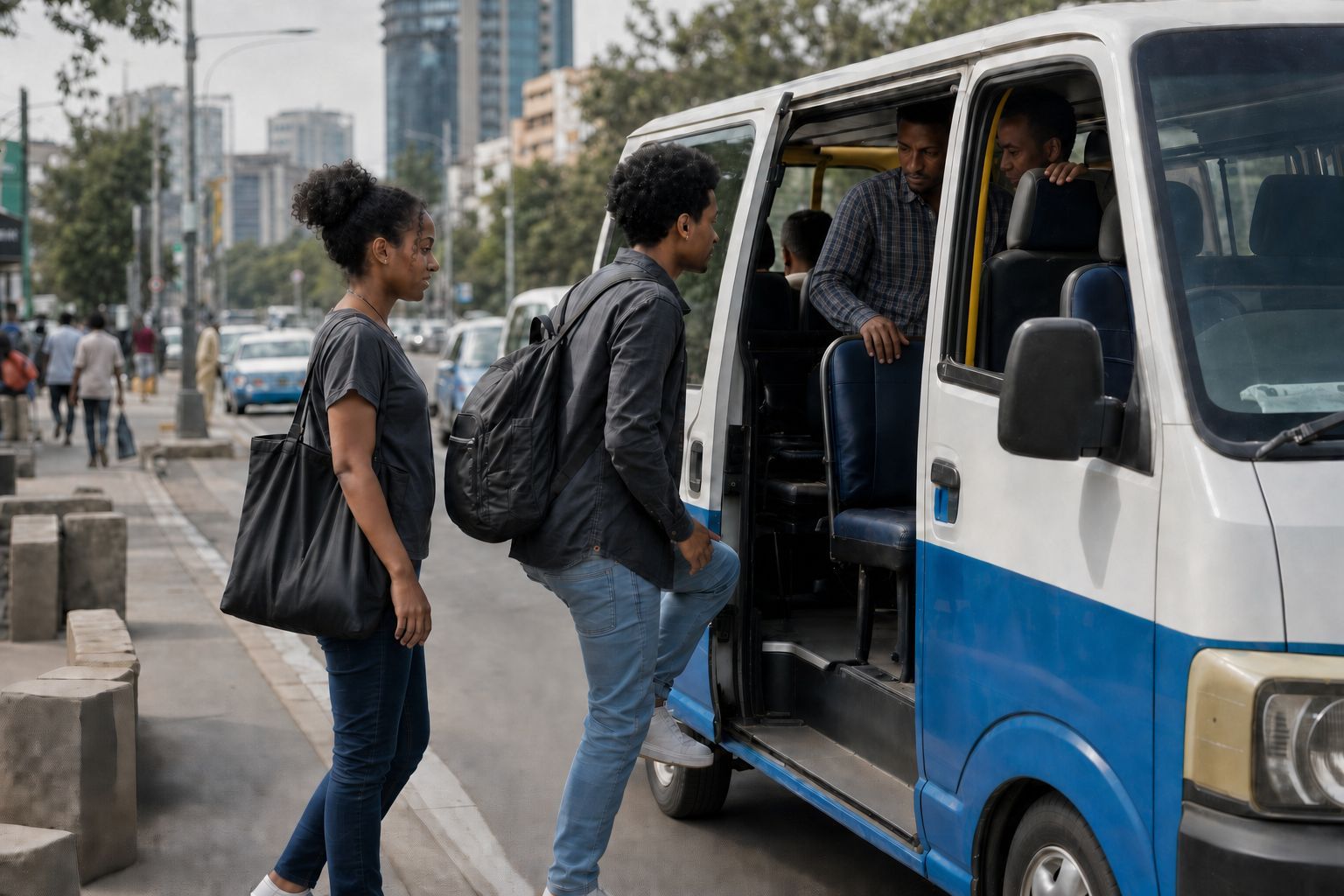
 Watch the route, listen for the destination, and confirm before boarding.
The first time you try to get somewhere in Addis, the system looks like chaos: vans stopping wherever they like, a young man hanging out the door shouting words you do not recognise, no visible timetable anywhere. It is not chaos. It is a dense, cheap, and surprisingly efficient network once you learn the handful of rules that everyone else already knows. Here they are. If you have not read the beginner’s guide to living in Addis Ababa yet, this fills in the transport section in much more detail.
Minibuses: the backbone
The blue and white minibuses are how most of the city moves. They run fixed routes, but with no printed schedule and no formal stops beyond junctions everyone already knows. Here is how they actually work.
Each minibus has a driver and a fare collector, called a weyala, who leans out and calls the destination as the van rolls past: “Megenagna, Megenagna,” or “Piassa, Piassa.” You listen for the place you want, wave the van down, and climb in. When it is time, you pass your fare forward to the weyala, who also gives change, so carry small notes.
A short trip starts around 15 birr (verified July 2026), with the fare rising for longer stretches. You often travel in legs, changing at a big junction rather than riding one van the whole way. The main hubs, places like Megenagna, Mexico, Meskel Square, Piassa, Merkato, and Stadium, are where routes meet and where you switch.
Minibuses are cheap and go almost everywhere. The downsides: they pack full at rush hour, and you need to know your route by its landmark names. When in doubt, say where you are going to the weyala or a fellow passenger and someone will point you to the right van. People are used to helping newcomers.
City buses: cheaper and slower
For longer routes and even lower fares, there are the larger public buses. The longtime public operator is Anbessa, and newer Sheger buses also run city routes. Routes and fares change, so confirm locally before you rely on one. They cost less than minibuses but come less often and move slowly in traffic. They suit an unhurried, budget trip more than a quick hop.
The light rail: skip the traffic
The Addis Ababa light rail is the one option that ignores road traffic entirely, because it runs on its own track. It runs on two lines. The east to west line goes from Ayat to Torhailoch, passing Megenagna, Meskel Square, and Mexico. The north to south line goes from Menelik II Square down through Merkato and Lideta to Kaliti. The fare is flat and low, no more than about 10 birr a ride (verified July 2026).
You buy a ticket at the station before boarding. If your origin and destination both sit near stations, the light rail is often the fastest and most predictable way across town, especially at rush hour when the roads lock up. If they do not, you will still need a minibus at one or both ends.
Ride hailing: the low stress option
When you do not want to learn routes or negotiate, use a ride hailing app. Several operate in Addis. The most used are Ride and Feres, with ZayRide another option. You set your pickup and destination, and the app handles the price, so there is no bargaining.
A trip across town runs roughly 350 to 500 birr (verified July 2026, more in heavy traffic). That is far more than a minibus, so it is best kept for airport runs, nights, unfamiliar areas, or when you are carrying things. Download one or two apps before you arrive and add a payment method once you have a local SIM and number.
Contract taxis and bajaj
Older private contract taxis still operate for door to door trips. There is no meter, so you agree the price before you get in. Ask a local what a fair rate is for your route so you have a number in mind.
In some outer areas you will also see bajaj, the three wheeled auto rickshaws, for short local hops. Their range and where they are allowed to operate varies, and they are restricted in parts of the center, so check what applies in your area.
How to pay
Most everyday transport is cash, so keep small notes and coins on you, especially for minibuses where the weyala needs to make change. Ride hailing apps take a linked payment method. Some services are adding mobile money options, so it is worth checking whether your usual route accepts Telebirr, but do not rely on it. Cash is still king on the street.
Timing and rush hour
Traffic in Addis is heavy and hardest in the late afternoon, roughly the end of the workday. A trip that is quick in the mid morning can double then. Two practical moves: use the light rail when your route allows, since it skips the jams, and pad your timing for anything important. If you can shift a trip out of the evening peak, do.
Safety and etiquette
- Keep your phone and wallet secure in packed minibuses and at busy junctions.
- Agree the price first in a contract taxi or bajaj.
- Pass your fare forward and have small change ready.
- If you are unsure of the route, ask before you board, not after.
- Offer your seat to elders and those who need it, as is normal here.
Common mistakes
- Waiting at a “stop” that does not exist. Flag the minibus down where it is already slowing, usually near a junction.
- Handing over a large note and expecting change on a short fare. Carry small money.
- Taking ride hailing everywhere and burning through your budget. Save it for when it earns its cost.
- Traveling across the city at 5 p.m. and blaming the transport. Blame the timing.
- Getting into a contract taxi without agreeing the fare first.
Putting it together
For daily life on a budget, minibuses and the light rail will cover almost everything, with walking for anything close. Keep a ride hailing app for the trips where convenience or safety is worth the extra cost, like arriving at the airport late or heading somewhere you do not know. Learn the names of the junctions between home and the places you go most, carry small change, and within a week the network that looked like chaos will feel routine. Once you have the basics down, the best places to visit in Addis Ababa is a good next stop, and if you are budgeting closely the cost of living breakdown shows where transport fits into a monthly total. For routes that continue beyond the city, begin with the weekend trips from Addis Ababa and confirm the return transport separately.